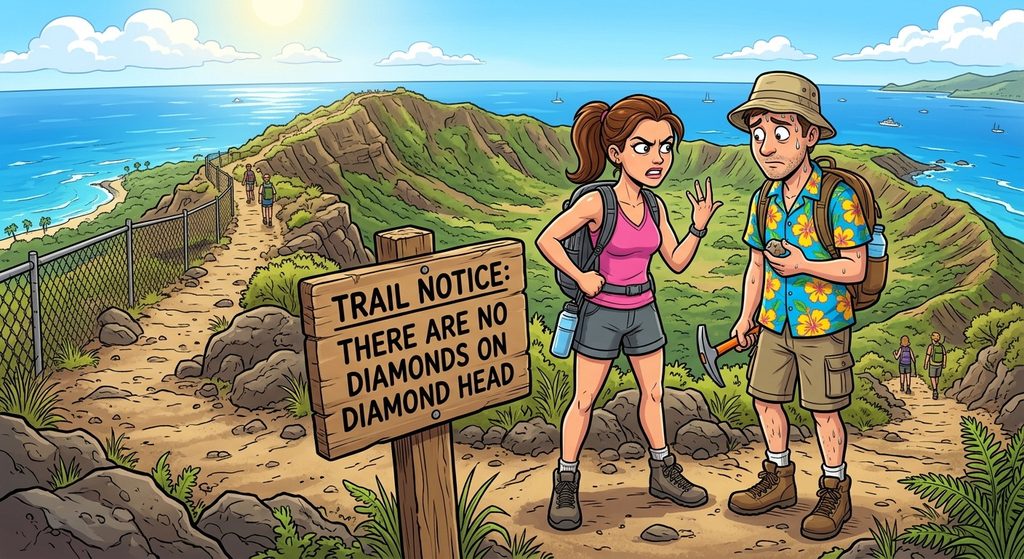
Since volcanic activity is central to the formation of diamonds, you would think Hawaii should be a Land of Diamond Paradise. But alas, the volcanic activity is the wrong kind for diamonds. There aren’t even any diamonds on Diamond Head.
Humorous Overview
It turns out the only things you’ll take home from Diamond Head are a killer calf workout and a massive sense of betrayal. Here are some jokes about hikers learning the hard way that names can be incredibly deceiving.
The Bait-and-Switch
- Why did the woman dump her boyfriend at the top of Oahu’s most famous volcanic cone?
Because he promised her a trip to Diamond Head to pick out a stone, but all he gave her was a bottle of lukewarm water and a 500-foot elevation gain. - What’s the difference between a highpointer on a romantic trip to Oahu and a geologist?
The geologist knows they are climbing a basaltic tuff cone. The highpointer is just trying to figure out how to hide a jewelry store receipt in his hiking pack before his girlfriend looks at the trail sign. - A hiker stands at the crater’s summit, holding a glittering piece of rock.
He turns to his partner and says, “Look, honey, I found a diamond!”
She sighs, checks her phone, and says, “Honey, that’s calcite. The only thing you’ve successfully mined today is my last nerve.”
One-Liners From the Trail
- “They call it Diamond Head because after you pay the non-resident park fee and climb all those concrete stairs in ninety-degree heat, your head starts throbbing like a diamond drill bit.”
- “I went up the trail looking for engagement rings, and all I found was an old military bunker. Which is perfect, because I’m going to need a place to hide from my girlfriend now.”
- “Diamond Head is the ultimate geological catfish. It promises you luxury gems but delivers nothing but volcanic ash and a gift shop selling overpriced shave ice.”
The Disappointed Rockhound
- Why are local geologists banned from leading romantic hikes up Diamond Head?
Because nothing ruins a proposal faster than a guy in khaki shorts yelling, “Put that back, it’s just a highly reflective carbonate mineral formed by low-temperature hydrothermal fluids!” - Why did the hiker bring a sifting pan to the crater rim?
He thought the “tuff” in basaltic tuff meant it would be really hard to find the diamonds.
Why Hawaii’s Volcanoes Can’t Make Diamonds
The famous volcanic cone on Oahu, Hawaii, contains zero diamond-producing geology. Instead, it is made entirely of basaltic tuff (hardened volcanic ash) formed during a brief, explosive marine eruption that occurred roughly 300,000 years ago.
The name is actually the result of a mistake made by British sailors in the 19th century:
- The Glittering Illusion: Sailors exploring the crater mistook calcite crystals embedded in the volcanic rock for real diamonds because they glittered brightly in the sunlight.
- The Geological Reality: Hawaii’s volcanoes originate from a relatively shallow oceanic hotspot. They lack the ancient, deep, stable continental cratonic roots (over 100 miles deep) and the specific high-pressure carbon chemistry required to create natural diamonds.
While volcanic activity is required to transport diamonds to the Earth’s surface, not all volcanoes are created equal.
The fundamental reason Hawaii’s volcanoes cannot produce diamonds comes down to depth, speed, and the source of the magma. Hawaii’s magma originates too shallowly and moves too slowly to form or preserve diamonds, unlike the explosive, deep-mantle eruptions found in continental diamond districts.
The table below contrasts the unique geology of Hawaii’s volcanic hotspot with diamond-bearing volcanic plumbing systems (Kimberlites and Lamproites):
| Geological Feature | Hawaii’s Hotspot Volcanoes | Diamond-Bearing Volcanoes (Kimberlite/Lamproite) | Why It Matters for Diamonds |
|---|---|---|---|
| Magma Source Depth | Shallow to Moderate: ~20 to 60 miles deep. | Ultra-Deep: 100 to 150+ miles deep. | Diamonds can only form in the “Diamond Stability Zone” under immense pressure found deeper than 90 miles. Hawaiian magma completely misses this zone. |
| Crustal Setting | Thin Oceanic Crust: Magma punches through young, thin (~3–5 miles thick) basaltic ocean floor. | Thick Continental Craton: Magma punches through ancient, cold, thick (~20–30+ miles) continental roots. | Thick, ancient continental roots act as a deep freezer/pressure cooker where carbon has been stored and compressed into diamonds over billions of years. |
| Eruption Speed | Slow and Oozing: Magma rises slowly over days or weeks, creating effusive lava flows. | Supersonic / Explosive: Gas-charged magma blasts to the surface in a matter of hours. | If magma moves too slowly, the dropping pressure causes diamonds to graphitize (turn into charcoal/graphite) or dissolve completely on the way up. They must be delivered like a rocket to survive. |
| Volatile Gas Content | Low to Moderate: Mostly water vapor and sulfur dioxide; low carbon dioxide. | Extremely High: Packed with trapped carbon dioxide (CO₂) and fluid gases. | High gas content acts like a shaken soda bottle, providing the immense explosive force needed to rapidly shoot deep rocks to the surface. |
| Rock Composition | Tholeiitic Basalt: Rich in iron and magnesium, poor in incompatible elements. | Ultramafic / Peralkaline: Ultra-rich in volatile fluids, potassium, and deep-mantle fragments. | Basaltic chemistry does not preserve mantle fragments (xenoliths) well; it melts them down rather than carrying them intact. |
Hawaii’s Glittering Calcite Diamond Frauds
Calcite is a common rock-forming carbonate mineral with the chemical formula CaCO₃ (calcium carbonate).
It is best known to rockhounds and hikers as the “nature’s trickster” mineral because its clear, highly reflective crystals frequently cause people to mistake it for diamond or quartz.
Calcite vs. Diamond: The Tell-Tale Differences
If you are standing on Diamond Head or a mountain trail trying to figure out if your sparkling find is a diamond or just calcite, here is how they directly compare:
| Property | Calcite | Real Diamond |
|---|---|---|
| Chemical Formula | CaCO₃ (Calcium, Carbon, Oxygen) | C (Pure Carbon) |
| Mohs Hardness | 3 (Very soft; can be scratched with a copper penny or pocket knife) | 10 (The hardest known natural mineral; scratches everything) |
| Crystal Shape | Rhombohedral (looks like a leaned-over box or a flattened cube) | Octahedral (looks like two pyramids glued base-to-base) |
| Cleavage | Perfect 3-direction cleavage (breaks cleanly into perfect miniature rhombs) | Octahedral cleavage (shatters or cleaves flat along pyramid faces) |
| The Acid Test | Fizzles immediately when exposed to weak acid like vinegar or household lemon juice. | Completely inert to acids. |
| Optical Properties | Strongly birefringent (Looking through clear calcite produces a double image) | Singly refractive (Produces a sharp, single image with high fire/dispersion) |
How Calcite Forms in Volcanic Basalt (Like Diamond Head)
While diamonds require the crushing pressures of the Earth’s mantle, calcite forms effortlessly at the surface through a process called hydrothermal deposition:
- The Trapped Gas: When lava erupts and cools, escaping volcanic gases leave behind round, empty pockets in the solid rock called vesicles.
- The Mineral Soup: Over time, rainwater or seawater filters down through the warm volcanic ash and basalt, dissolving calcium from the rock.
- The Crystal Growth: As this mineral-rich water seeps into the empty gas pockets and evaporates, it leaves behind layers of calcium carbonate. These grow into the beautiful, glittering white calcite crystal clusters (often called vugs or geodes) that fooled the 19th-century sailors.