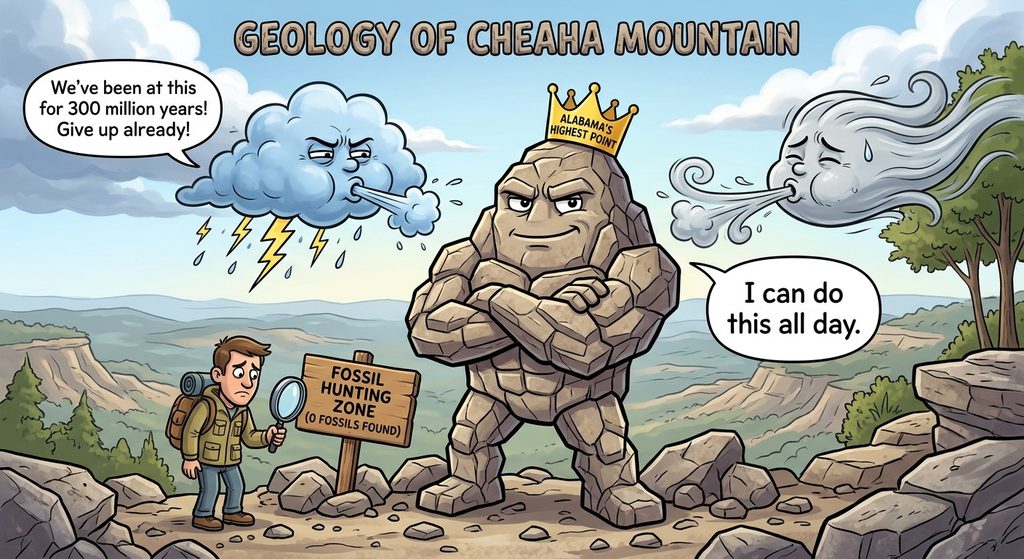
The summit of Cheaha Mountain is defined by an incredibly resilient and ancient rock formation that shapes its steep cliffs, jagged ridges, and long-range vistas.
Humorous Overview
Here are a few quick geological jokes centered around Cheaha Mountain and its ultra-stubborn rock formations:
- The Ultimate Couch Potato: Cheaha Quartzite is so incredibly hard and resistant to weathering that geologists consider it the ultimate couch potato of the rock world—it hasn’t moved or changed its look in 300 million years.
- Tectonic Ghosting: When Gondwana slammed into Laurasia during the Alleghenian Orogeny, the Talladega Thrust Fault pushed Cheaha Quartzite all the way to the top and completely ghosted the softer limestones down in the valley.
- The No-Fossil Zone: Searching for a prehistoric fossil on the summit of Cheaha Mountain is a great way to waste an afternoon. The metamorphic heat and pressure baked that stone so thoroughly that any ancient creature unlucky enough to be inside was turned into a literal countertop.
- Erosion’s Worst Nightmare: Rain and wind have been trying to wear down Cheaha Mountain for millions of years, but the peak’s quartzite shield is basically the geological equivalent of replying “I can do this all day.”
- A Diamond’s Jealous Cousin: Alabamians love to brag that Cheaha Quartzite is so tightly interlocked and dense it can scratch glass and rival granite—which is just a polite way of saying it’s completely worthless to mine, but it makes an excellent staircase for Bunker Tower.
Key Geological Features
- Cheaha Quartzite: The mountain’s summit ridge is composed of Cheaha Quartzite, a highly durable, metamorphosed sandstone dating back to the Paleozoic era. This rock is packed with tightly interlocking quartz grains, making it extraordinarily hard and resistant to erosion, far more than the softer shales and limestones in the surrounding valleys.
- The “Sky Island” Tectonic Thrust: Cheaha is part of the Talladega Uplift. Tectonic forces millions of years ago pushed these ancient metamorphic rock layers upward along fault lines. Because the quartzite caps the ridge like a protective shield, the surrounding landscape eroded away over millennia, leaving Cheaha standing alone as a sheer, elevated topographic ridge rising abruptly out of the flat lowlands.
- Granite-Like Boulder Fields: Over vast expanses of time, freeze-thaw cycles fractured the quartzite along natural joint lines. This created the massive, dramatic rock outcroppings and sheer drop-offs seen at popular spots like Bald Rock and Pulpit Rock, as well as the steep boulder fields that challenge hikers on the lower slopes.
Geologic History
Here is a deeper look into both the intense structural forces that shaped Alabama’s highpoint and the ancient life trapped within the sedimentary layers of its neighbors.
The Talladega Uplift & Fault Lines
The dramatic height of Cheaha Mountain is a direct result of ancient continental smash-ups along the Talladega Thrust Fault.
- The Collision: Roughly 300 million years ago, during the Alleghenian Orogeny, the supercontinent of Gondwana collided with Laurasia, forming Pangea. This titanic pressure squeezed the Earth’s crust like a giant rug.
- The Thrust: The immense pressure snapped deep bedrock layers, forcing a massive wedge of ancient metamorphic rock upward and westward over younger, softer sedimentary rocks. This specific wedge is known as the Talladega Uplift.
- The Ridge Maker: Because the ultra-hard Cheaha Quartzite sat right at the top of this thrust sheet, it acted like a protective armor plating. While the softer shales in the Coosa Valley to the west eroded down by thousands of feet over millions of years, the quartzite ridge refused to wear away, leaving Cheaha standing tall as a sheer mountain wall.
Fossils & Minerals of Neighboring Formations
While the extreme heat and pressure of the mountain-building process completely wiped out or baked away any fossil evidence on Cheaha, Brasstown Bald, and Clingmans Dome, the story changes dramatically as you move into the lower, un-melted sedimentary highpoints:
- Woodall Mountain (Mississippi):
- Fossils: Because these iron-rich sandstones formed along an ancient Cretaceous coastline, they are highly sought after by local geologists. Marine sands here frequently yield fossilized shark teeth, ancient oyster shells (Exogyra), and the burrowing trails of prehistoric marine worms.
- Minerals: The hill is dominated by limonite and goethite (dark iron oxides), which bind the sand grains together into a dense, rust-colored crust.
- Britton Hill (Florida):
- Fossils: The sand ridge itself contains few distinct fossils, but it lies directly atop the sprawling Florida Limestone Platform. This deep bedrock layer is composed entirely of the compressed skeletal remains of billions of prehistoric corals, sea urchins, and marine mollusks from when Florida was submerged in a warm, shallow sea.
- Minerals: The sands are predominantly pure quartz, but they also contain trace amounts of heavy minerals such as ilmenite, rutile, and zircon, which were washed down from the eroding Appalachian Mountains millions of years ago.