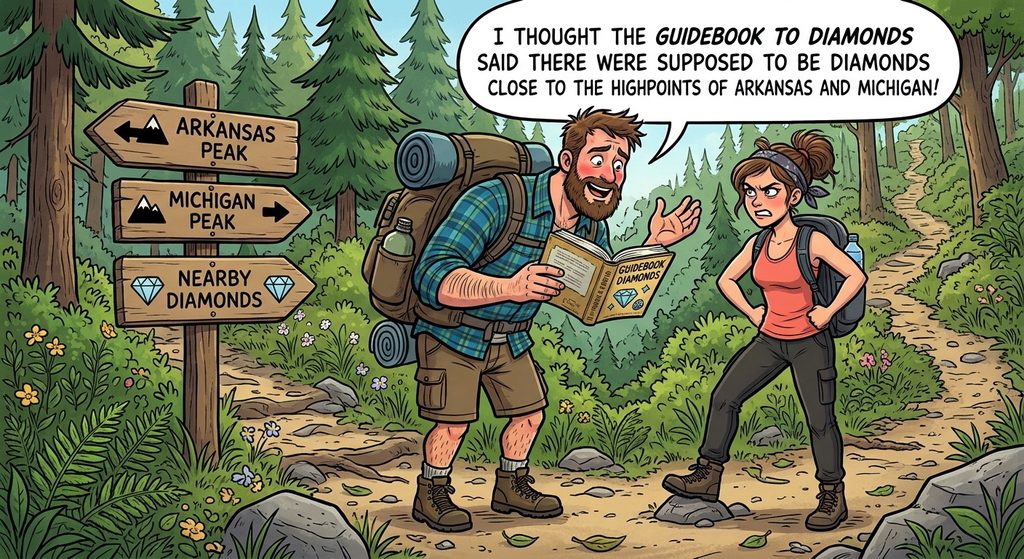
The geology of both Mount Magazine and Mount Arvon/Curwood includes nearby volcanic activity that has resulted in diamonds being found close to the highpoints (112 miles in Arkansas and 65 miles in Michigan)
Humorous Overview
Pack your sifting pans alongside your hiking poles, because these highpointers are looking for more than just a summit register.
Here are some jokes about the ultimate cross-over hobby: highpointing for diamonds.
The Multi-Tasking Highpointer
- Why did the highpointer bring a magnifying glass to the summit of Mount Arvon?
Because checking off the state peak wasn’t enough—he wanted to see if the microscopic Michigan diamonds matched his microscopic cell service. - Why are highpointers the worst at secret diamond hunting expeditions on Mount Magazine?
The second they find a shiny stone, they try to build a tiny cairn out of it. - How do you know a highpointer has spent too much time researching the geology around Mount Arvon?
They start claiming that the brutal swarm of Upper Peninsula mosquitoes is actually just an airborne swarm of “indicator minerals.”
Summit Stereotypes
- Highpointer: “I’ve scaled Mount Elbert, Gannett Peak, and Mount Magazine!”
Geologist: “Wow, you must love deep crustal basements and sedimentary formations.”
Highpointer: “Actually, I just keep hoping if I trip and fall hard enough on the summit, a kimberlite pipe will open up.” - What’s the difference between a regular rockhound and a highpointer at Crater of Diamonds?
The rockhound looks for diamonds in the dirt. The highpointer climbs to the top of the nearest park bathroom just to say they bagged the highest point in the mining district. - Why did the peakbagger refuse to look for gems anywhere but the absolute highest rock on Mount Magazine?
He said he only deals in “high-pressure, high-carat, high-altitude” disappointments.
One-Liners From the Trail
- “I went diamond hunting on Mount Arvon, and all I found was a rock that costs exactly what my divorce did after spending our savings on rugged logging road tires.”
- “Trying to find a macroscopic gem on Mount Arvon is like trying to find the actual summit marker in the dense Michigan woods—even if you’re standing right on top of it, you still can’t see it.”
- “My favorite highpointing expedition is doing Mount Magazine and Crater of Diamonds in the same day. That way, when I fail to find a gem, I can just sit on the sedimentary sandstone and cry at a higher elevation.”
Overview
While both states feature high points situated relatively close to diamond-bearing geology compared to the rest of the country, Arkansas offers an active, world-class public diamond-hunting opportunity near its peak, whereas Michigan offers zero practical diamond-hunting opportunities near its peak.
The stark contrast between what you can actually do near Mount Magazine versus Mount Arvon comes down to accessibility, rock types, and the physical size of the diamonds:
| Feature | Arkansas (Near Mount Magazine) | Michigan (Near Mount River / Mount Arvon) |
|---|---|---|
| High Point | Mount Magazine (Logan County) | Mount Arvon (Baraga County) |
| Nearest Diamond Site | Crater of Diamonds State Park (Murfreesboro) | Iron County Kimberlite Zone (Lake Ellen Pipe) |
| Driving Distance from Peak | ~112 miles (~2.5 hours south) | ~65 miles (~1.5 to 2 hours south) |
| Diamond Abundance | High. Over 35,000 diamonds found by visitors; averaging 1–2 finds per day. | Extremely Low. Fewer than a dozen tiny crystals ever recovered by corporate geologists. |
| Diamond Size | Macroscopic. Stones range from match-head size to historic multi-carat gems. | Microscopic. Grains are invisible to the naked eye and require lab equipment to see. |
| Public Hunting Allowed? | Yes. It is a public state park. Anyone can pay a small fee to dig and keep their finds. | No. Sites are located on remote corporate timberlands or private property with no public digging facilities. |
| Geological Setting | An eroded, open-air plow field sitting directly over a lamproite volcanic pipe. | Overgrown, glaciated terrain where the kimberlite is mostly buried or heavily eroded. |
Diamond Development Process Differences
The geological environments that allow diamonds to form and reach the surface are incredibly specific. While Arkansas possesses a classic, highly explosive mantle-derived volcanic pipe, the diamond-bearing zone in Michigan relies on ancient cratonic root stability that allowed deep-seated magma to pass through.
The table below contrasts the specific geological features of both states that are conducive to preserving and transporting diamonds from the deep Earth:
| Geological Feature | Arkansas Diamond Geology | Michigan Diamond Geology |
|---|---|---|
| Primary Host Rock | Olivine Lamproite (Prairie Creek diatreme) | Kimberlite (Lake Ellen and related pipes) |
| Tectonic Setting | Continental Rifting: Formed during the breakup of the Gulf of Mexico basin, creating deep structural faults. | Stable Craton Core: Sits on the southern edge of the ancient, stable Archean/Proterozoic Canadian Shield. |
| Geological Age | Cretaceous Period (~100 million years old) | Paleozoic Era (~370 to 450 million years old) |
| Depth of Origin | ~100+ miles deep (Upper mantle diamond stability field) | ~90 to 120 miles deep (Root of the North American craton) |
| Eruption Style | Gas-charged, supersonic “maar” eruption that blasted a broad, shallow crater into existing shallow seas. | High-pressure, rapid vertical migration forming deep, narrow “carrot-shaped” volcanic pipes. |
| Erosion & Preservation | The original volcanic cone eroded, concentrating heavy diamonds into the soft, weathered soil matrix at the surface. | Heavy glacial scraping during the last Ice Age sheared off the tops of pipes and buried them under thick glacial drift. |
| Key Co-Existing Minerals | Chromite, phlogopite mica, barite, peridot, and amethyst. | Chrome pyrope garnet, picroilmenite, chrome diopside, and olivine. |
Summit Geology Is Different from the Diamond Geology
The summits of Mount Arvon and Mount Magazine are entirely separate from the volcanic pipes found nearby, forming distinct geological systems.
The summits are built from crustal basement rocks and surface sediments formed under moderate temperatures, while the nearby diamond areas were forged in the superheated, high-pressure environment of the Earth’s deep mantle and blasted to the surface by explosive volcanism.
The table below contrasts the summit geology of each peak with its respective state’s diamond-bearing zones:
Michigan: Mount Arvon vs. Iron County Kimberlites
| Feature | Mount Arvon Summit Geology | Nearby Kimberlite Zone (Lake Ellen) |
|---|---|---|
| Rock Category | Metamorphic & Igneous Basement | Ultramafic Volcanic (Mantle) |
| Primary Rock Types | Ancient granite, gneiss, quartzite, and slate. | Kimberlite (altered olivine, phlogopite). |
| Environment of Formation | Continental crust compressed by ancient mountain-building collisions. | Formed 100+ miles deep in the mantle; erupted rapidly through fractures. |
| Geological Age | Archean / Paleoproterozoic (~1.8 to 2.7+ billion years old). | Paleozoic (~370 to 450 million years old). |
| Presence of Diamonds | None. Crustal temperatures were far too low, and pressure was insufficient. | Microscopic. Contains trace amounts of microdiamonds. |
Arkansas: Mount Magazine vs. Crater of Diamonds
| Feature | Mount Magazine Summit Geology | Nearby Diamond Area (Prairie Creek) |
|---|---|---|
| Rock Category | Sedimentary Layers | Ultramafic Volcanic (Mantle) |
| Primary Rock Types | Tough, erosion-resistant Savanna Sandstone and shale. | Olivine Lamproite tuff, breccia, and porphyry. |
| Environment of Formation | Ancient delta systems depositing sand and mud in a sinking shallow sea. | Deep mantle melt driven upwards by volatile gas expansions. |
| Geological Age | Pennsylvanian Period (~300 million years old). | Cretaceous Period (~100 million years old). |
| Presence of Diamonds | None. Surface river mud and sand deposits cannot form or hold diamonds. | Macroscopic. Richly endowed with gem-quality diamonds up to several carats. |