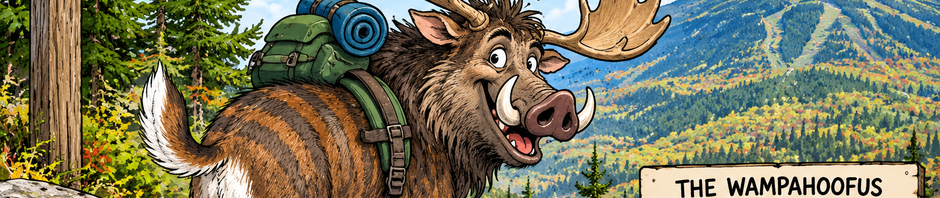
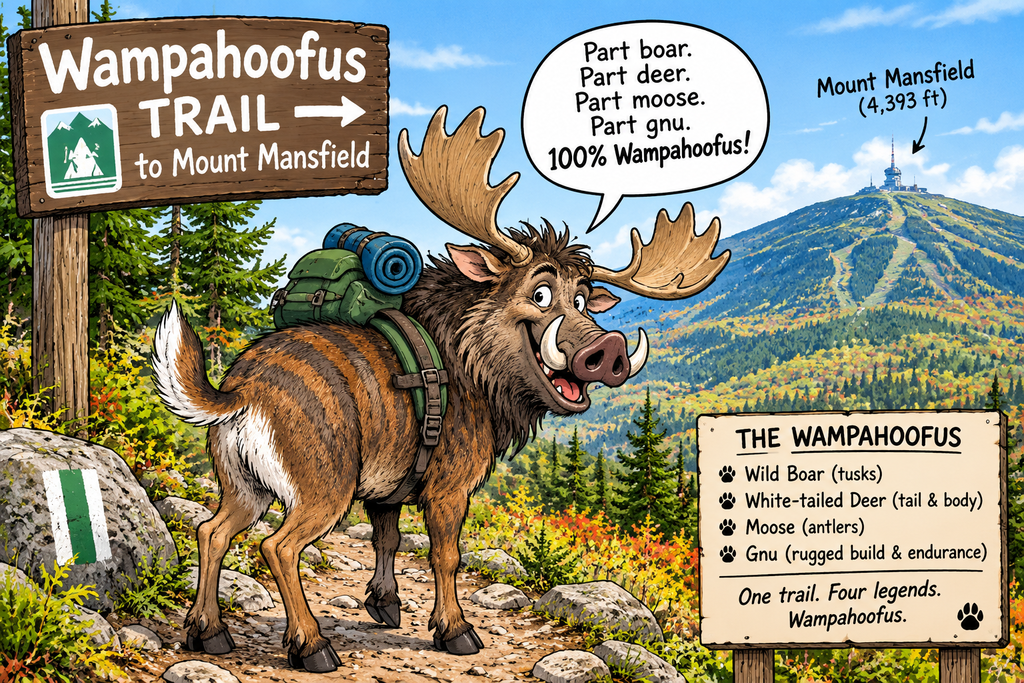
The story of the Wampahoofus is a classic piece of American “fearsome critter” folklore. It originated in the 19th-century logging camps of the Green Mountains, where lumberjacks spun wild camp stories to pass the long winter nights and prank unsuspecting newcomers. The tale has since become permanently tied to the rugged terrain of Mount Mansfield.
Wampahoofus Jokes
Here are some original one-liners and jokes about Mount Mansfield’s favorite lopsided cryptid:
- Why did the Wampahoofus break up with his girlfriend?
Because they were constantly walking in circles, and he felt like they were just going in opposite directions. - Why is it so hard to get a good photograph of the Wampahoofus on Mount Mansfield?
Because whenever a hiker tells it to stand level and look at the camera, it completely collapses. - What happens when two male Wampahoofuses meet head-on along a narrow ledge on the Wampahoofus Trail?
An absolute standstill—neither one can back down, and neither one has the right legs to turn over a new leaf. - Why did the Wampahoofus fail its driver’s education test on the mountain?
It could only make right turns and kept drifting into the downhill ditch. - Hikers on Mount Mansfield always know when a Wampahoofus is nearby.
You can easily hear the distinct, rhythmic sound of “thump-tap, thump-tap” as it wobbles its way across the ridge line. - Why don’t you ever see a Wampahoofus hanging out at the very summit of the Chin?
Because the top of the mountain is perfectly flat, and it has absolutely zero balance on a level playing field. - Why did the 19th-century Vermont lumberjacks love telling stories about the Wampahoofus?
Because it was the only creature on the mountain that was more lopsided than a greenhorn logger after a night at the local tavern.
- What did the Vermont park ranger say to the hikers looking for the Wampahoofus?
“If you want to catch him, just wait on the trail—he’s legally obligated to come back around eventually.” - Why is the Wampahoofus terrible at playing hide-and-seek?
Because its tracks always leave a perfect, deep trench on the downhill side that points exactly where it’s going. - What do you call a Wampahoofus that somehow manages to turn around and face downhill?
A tumbling boulder. - Why did the Wampahoofus refuse to join the other Vermont cryptids for a card game at Lake Champlain?
It couldn’t deal with a flat deck. - How do you know a Wampahoofus has been raiding the trash cans at Butler Lodge?
All the bins are tipped over to the right, and the footprints show a very clumsy getaway. - Why did the University of Vermont professor name the trail after the creature?
Because after scrambling up those steep, uneven rocks, his legs felt exactly like the monster’s. - What’s the difference between a Mount Mansfield tourist and a Wampahoofus?
The Wampahoofus actually knows how to handle a steep incline without complaining about its knees. - Why don’t you ever see a Wampahoofus running a marathon?
The track is a loop, but half the time it would be running on its long legs, and it simply can’t stand the level competition.
Anatomy of a Mountain Beast
According to old-time logger lore, the Wampahoofus is a large, solitary mammal that looks like a bizarre hybrid between a wild boar and a white-tailed deer—though some swear it resembles a moose mixed with a gnu. It is said to have thick fur ranging from mossy green to brilliant orange, and a voice that sounds like a shrill tail whistle. [1, 2, 3, 4, 5]
Its most famous trait, however, is its asymmetrical legs. To survive on the steep, rocky inclines of Mount Mansfield, the Wampahoofus evolved with the legs on one side of their bodies significantly shorter than those on the other side. This allowed the creature to dart horizontally across sheer mountain slopes with perfect stability, as long as its long legs stayed on the downhill side. [1, 2, 3, 4]
The Evolutionary Glitch
This brilliant physical adaptation came with a hilarious, highly specialized catch: the Wampahoofus could only walk in one direction. It could never walk on level ground without toppling over, and it could never turn around. [1, 2, 3]
This created a strict social dynamic on the mountain:
- The Clockwise Males: Male Wampahoofuses were born with shorter right legs, so they could only circle Mount Mansfield clockwise. [1, 2]
- The Counterclockwise Females: Females were born with shorter left legs, which forced them to circle the mountain counterclockwise. [1, 2, 3]
Because of this, males and females lived entirely separate lives for most of the year, restricted to a narrow elevation band between 2,600 and 3,200 feet. However, things became incredibly complicated when their paths crossed: [1, 2]
- Mating: Once a year, the two opposite-circling paths would intersect midslope. Because they were moving in opposite directions, physical alignment was an absolute genetic puzzle. Folklore says a clever pair once managed to migrate through a flat valley by leaning tightly against one another—combining their two sets of long legs like “a pair of drunks walking home from town”—but such coordination was rare. [1, 2, 3, 4]
- Territorial Standoffs: If two males or two females with the same limb configuration met head-on along a narrow ledge, neither could step backward or turn around. Trapped by their own anatomy, they had no choice but to fight to the death until one fell off the mountain. [1, 2, 3]
A Sad Extinction
The lumberjacks claimed that this extreme specialization ultimately doomed the species. Over many generations, the uneven leg gene became dominant. The short legs of the males and females kept shrinking and shrinking. Eventually, their limbs became so severely mismatched that they couldn’t stand up to graze or successfully mate, causing the unique creatures to fade into extinction. Loggers claimed that the small, step-like ridges visible on Vermont’s grassy hillsides today (known scientifically as terracettes) are actually the ancient, eroded trails gouged out by centuries of circling Wampahoofuses. [1, 2, 3, 4, 5, 6]
The Legacy on Mount Mansfield
While the beast is gone, its name lives on. In 1935, a University of Vermont professor named Roy O. Buchanan was mapping a trail on the rugged slopes of Mount Mansfield. He encountered a strange, weathered rock formation that bore an uncanny resemblance to the legendary creature from old logging camp stories. [1, 2]
He officially dubbed the path the Wampahoofus Trail. Today, adventurous hikers can still tackle this steep, rocky scramble, which ascends from Butler Lodge up toward the Forehead of Mount Mansfield—just make sure you keep an eye out for any low-side wobbling shadows in the trees.
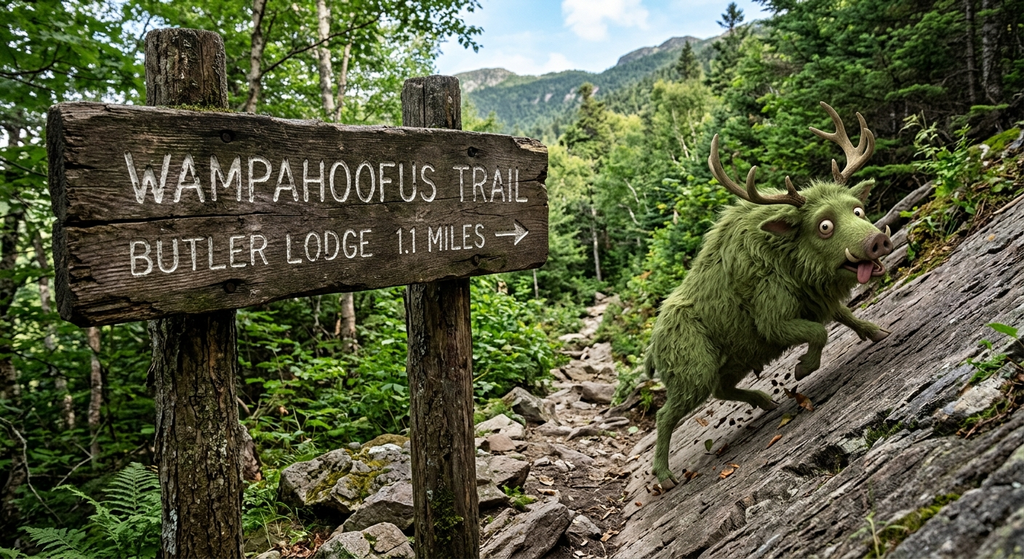
Reason It Is Portrayed As Green
The reason the Wampahoofus is consistently portrayed as green comes down to a specific detail buried right inside the original 19th-century logging camp folklore:
- Natural Camouflage: According to old-time logger lore, the Wampahoofus developed thick fur that ranged from mossy green to dark evergreen. This vibrant coloration allowed the solitary beast to blend seamlessly into the dense coniferous forests and moss-covered boulder fields of Mount Mansfield, keeping it perfectly hidden from predators and loggers alike.
- The “Fearsome Critter” Style: In early American folklore, loggers loved giving their mythical creatures bizarre, plant-like features to make them sound like physical extensions of the wilderness itself. Making the creature green visually tied it to the wild, untouched landscape of Vermont.
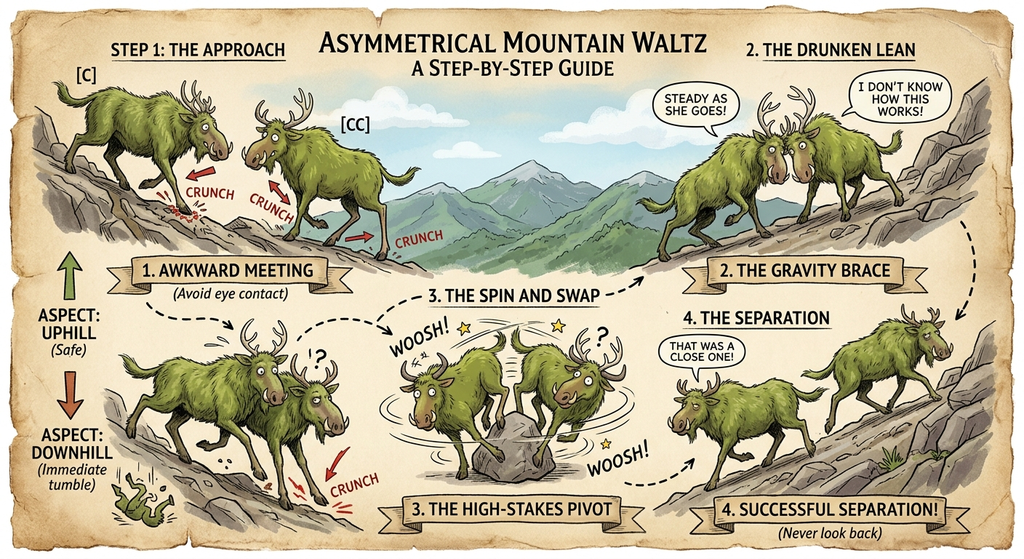
The Asymmetrical Mountain Waltz: A Step-by-Step Guide
According to Vermont logging lore, when a clockwise male meets a counterclockwise female mid-slope on Mount Mansfield, they have to perform a complex, highly coordinated “dance” just to stay upright. Here is how the legendary step-by-step instructional diagram breaks down:
Key Rules of the Wampahoofus Waltz:
- Never Face Downhill: If either creature accidentally points its lopsided body straight down the slope during the spin, it immediately transitions from a dance partner into a rolling green boulder.
- The Balanced Buddy System: Loggers noted that if a pair needed to migrate across a perfectly flat valley, they would perform Step 2 indefinitely—bracing against each other tightly to walk straight, closely resembling two tired hikers stumbling home from a local tavern. [1]
The 19th-Century Newspaper Traveling Hoax
During the 1800s, Yankee showmen took advantage of the era’s lack of photographic verification to stage a highly popular, circus-style traveling prank. [1]
- The “Captured” Beast: Two entrepreneurs would roll into a town advertising that they had successfully captured a live Wampahoofus (frequently called a Gyascutus in these traveling formats). [1]
- The Show: Eager townsfolk would pay admission to enter a dark tent. All they could see of the creature was a pair of large, terrifying, furry feet peeking out from beneath a massive, heavy curtain. [1]
- The Escape: The showman would poke the curtain with a stick, triggering a cacophony of ferocious growls, rattles, and horrific screams from behind the drapery. Suddenly, an assistant would set off an emergency alarm screaming that the beast had broken its chains. [1]
- The Media Frenzy: The crowd would flee in terror. The next morning, a local newspaper would run a tongue-in-cheek article warning the populace that a “formidable animal” was on the loose and threatening the area’s peace. By the time anyone caught on, the showmen had moved three towns over, set up their curtain, and prepared to “lose” the beast all over again.
Story History
The first mention of the Wampahoofus as a distinct, named creature dates back to the 1800s, before the American Civil War, and emerged organically from oral storytelling in the lumber camps of northern New England. [1]
Because it was part of an unwritten tradition of “fearsome critters” passed down by loggers around campfires, there is no single, definitive “first publication” date for the specific Vermont variant. However, its history follows a clear timeline as it transitioned from spoken jokes into a permanent fixture of Vermont culture: [1, 2]
The 19th-Century Oral Origins (The 1800s)
Long before it appeared on any maps, the story of the Wampahoofus was a staple of the 19th-century timber industry. Loggers spending long, isolated winters in remote mountain camps invented the creature to pass the time and haze city-slicker newcomers. During this era, traveling showmen in the Northeast and Midwest would sometimes prank audiences by setting up tents claiming to hold a captured, ferocious “Wampahoofus”. They would shake the tent curtains and cause a ruckus before setting off an alarm, claiming the beast had escaped into the night—prompting local newspapers to warn residents, tongue-in-cheek, about a “formidable animal” on the loose. [1, 2]
The Ancient “Sidehill” Ancestry (1646)
While the name Wampahoofus belongs strictly to Vermont folklore, the concept of a creature with mismatched legs for mountain walking is much older. The absolute earliest documented mention of a sidehill creature occurred in 1646 in England. The British polymath Sir Thomas Browne wrote about a popular folk belief that badgers had legs that were shorter on one side than the other. When English and Scottish settlers moved to the rugged terrain of New England, they adapted this ancient piece of folklore into new monsters like the Gyascutus, the Sidehill Gouger, and ultimately, Vermont’s Wampahoofus. [1, 2, 3]
3. Transition to Print and Maps (1935)
The legend made the leap from temporary campfire folklore to permanent geographical history in 1935. While surveying and mapping the rugged slopes near Butler Lodge on Mount Mansfield, University of Vermont professor Roy O. Buchanan came across a peculiar rock formation that looked like a lopsided beast. Familiar with the old logging camp tales, he officially named the trail the Wampahoofus Trail. This marked the creature’s formal introduction into New England hiking lore and print state history, ensuring the 19th-century joke would never be forgotten.