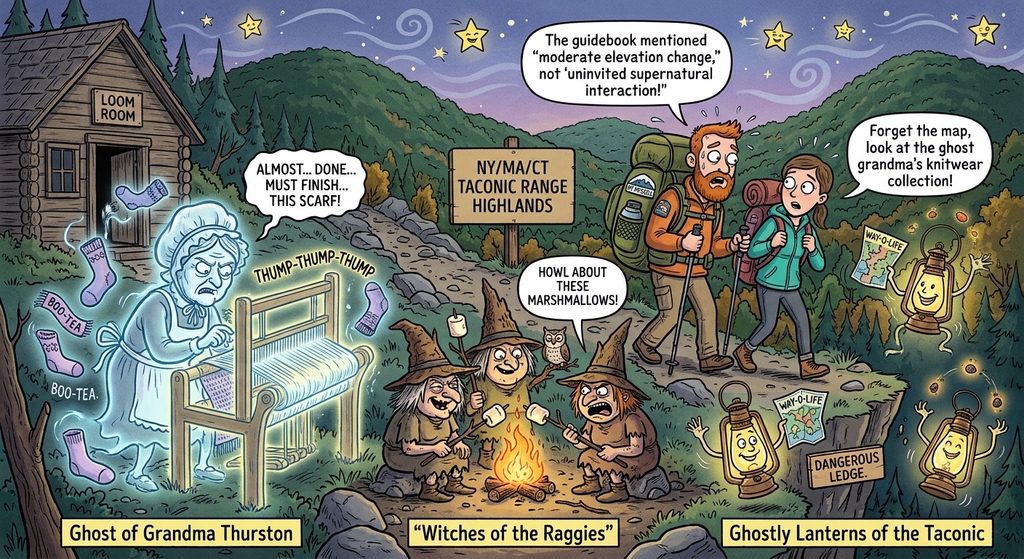
Climbing Mount Frissell in daylight may not be a big deal. But doing it at night, you might encounter the Ghost of Grandma Thurston, the Witches of the Raggies, or the Ghostly Lanterns of the Taconic. You have to wonder if they named it for a Presbyterian minister in order to ward off the spirits.
Jokes
Ghostly Lanterns of the Taconic
- The Ghostly Lanterns of the Taconic are famous for leading hikers deep into treacherous swamps. It’s not an act of historical malice; it’s just that a 19th-century oil lantern has a terrible GPS signal and absolutely zero satellite updates.
- You know you’ve encountered a modern Taconic ghost when the mysterious bobbing light stays permanently out of reach because the spirit is actively trying to find enough cellular bars to refresh its maps.
- A hiker tried to follow a ghostly lantern through a blinding mountain fog, only to discover the spirit was just waving a flickering smartphone flashlight with 3% battery life left.
- Skeptics argue the ghostly lights are actually just “foxfire”—a bioluminescent fungus growing on rotting wood. Local hikers agree, noting it’s the only thing on the mountain that stays illuminated without an expensive REI membership.
- The legend warns that following the lanterns will lead you straight into a high alpine bog. Locals say that’s not a supernatural curse—that’s just the standard user experience of the Appalachian Trail in the springtime.
- The old colliers had to watch their smoldering charcoal pits 24 hours a day. Today, their ghosts continue the tradition by hovering over modern campsites, mostly to silently judge how long it takes a millennial to light a basic fire starter.
- Many modern “ghostly lantern” sightings are actually just the headlights of 4×4 vehicles bouncing down Mount Riga Road. The real supernatural mystery is how those subcompact rental cars managed to survive the rocks without tearing out their oil pans.
- A ghost hunter spent three hours tracking a swaying amber light through the dense Taconic tree canopy, only to find out it was a local resident checking their mailbox with a vintage Coleman lantern because the porch light burned out in 1994.
Ghost of Grandma Thurston
- Grandma Thurston’s ghost is famous for keeping residents awake by operating a heavy wooden textile loom at 2:00 AM. It’s not an act of supernatural terror; she’s just trying to finish a massive backlog of holiday sweaters for her spectral grandkids.
- A resident of the Wentworth House once tried to confront the ghost about the constant late-night thump-thump noises coming from the loom room. Grandma Thurston’s spirit reportedly replied, “Unless you’re going to help me thread this warp, go back to sleep.”
- You know you’re dealing with a colonial grandma ghost when she tries to manifest as a terrifying, wispy apparition but stops halfway through because she noticed your shirt is missing a button and your posture is terrible.
- Ed and Lorraine Warren famously hiked up Mount Riga completely uninvited to investigate the loom room. Legend has it they left immediately after Grandma Thurston spent three straight hours showing them her extensive collection of phantom porcelain thimbles.
- When the Warrens brought their high-tech audio equipment into the Wentworth House to capture Electronic Voice Phenomena (EVP), the only recording they got was a faint, disembodied whisper muttering, “You look so thin, Edward, let me bake you a spectral biscuit.”
- Skeptics claim the rhythmic thump-thump of the loom was just the sound of high mountain winds rattling the old wooden siding. Local ghost hunters disagree, arguing that wind doesn’t accidentally produce a perfectly stitched, vintage flannel pattern.
- The ultimate irony of Grandma Thurston’s haunting is that she spent her entire afterlife weaving textiles on a remote mountain summit, only for modern hikers to pass by wearing 100% synthetic neon fleece that she wouldn’t touch with a ten-foot shuttle.
Witch Howls of the Raggies
- Superstitious townspeople down in Salisbury used to freeze in terror at the sound of blood-curdling “witch howls” echoing off the mountain cliffs. Today, naturalists have confirmed it was just a bunch of bored whippoorwills and barred owls having a passionate, high-altitude argument about territory.
- The locals thought the haunting cries were a supernatural coven casting ancient hexes on the valley crops. In reality, it was just an isolated mountain resident who had stepped on a very sharp piece of Salisbury iron ore while barefoot in the dark.
- If you hear a terrifying, disembodied wail echoing through the Mount Riga woods tonight, don’t worry about witches. It’s just a modern hiker who checked their phone and realized they have absolutely zero cell service to load their trail maps.
- The “Raggies” lived in such intense, off-grid isolation on the mountain that the towns below mythologized them as mystical beings. The true mystery wasn’t their alleged witchcraft; it was how they managed to survive a brutal Connecticut winter without a single trip to a local Dunkin’.
- A 19th-century traveler claimed he heard a rhythmic, ghostly chanting coming from a secluded cabin deep in the Mount Riga hollows. It turned out to be a family just trying to figure out whose turn it was to haul water up a 40-degree incline.
- People whispered that the mountain dwellers possessed secret, dark magic to navigate the treacherous cliffs in the pitch black. It wasn’t magic—they just had the ultimate evolutionary advantage of not owning a single pair of slippery modern sneakers.
Origin Stories
Ghostly Lanterns of the Taconic
The legend of the Ghostly Lanterns of the Taconic is a classic piece of mountain folklore tied directly to the rugged Taconic Range, right where the borders of New York, Connecticut, and Massachusetts collide—a high-altitude ridge system that includes both Mount Riga and Mount Frissell.
Rather than centering on a haunted house or a specific room, this phantom phenomenon belongs to the dark, densely wooded trails and deep ravines of the mountain chain.
The roots of the ghostly lanterns stem directly from the 19th-century iron boom that dominated Mount Riga and the surrounding Taconic peaks. To keep the massive iron blast furnaces roaring 24 hours a day, the iron companies relied on colliers (charcoal burners).
- The Job: These men lived isolated, lonely lives deep in the Taconic forests, cutting down massive tracts of timber and carefully smoldering the wood under dirt mounds to produce charcoal.
- The Danger: Colliers had to tend to these smoldering pits around the clock, frequently carrying handheld oil or kerosene lanterns through pitch-black, blinding mountain storms to prevent the pits from catching fire and destroying their livelihood.
- The Tragedy: According to regional folklore, several colliers perished over the decades—some swallowed by freak mountain blizzards, others tumbling off jagged cliffs into steep ravines like Sage’s Ravine, and some suffocated by the toxic fumes of their own charcoal pits.
For well over a century, locals from Salisbury, Connecticut, and Copake, New York, as well as night-trekking hikers on the Appalachian Trail, have reported seeing mysterious bobbing lights shifting through the dense mountain forests.
- The Behavior: The lights are almost always described as low, amber-colored glows that mimic the gentle swaying motion of an old-fashioned oil lantern being carried by an invisible walker.
- The Trick: Legend warns that these lanterns are highly deceptive. Lost travelers or stranded hikers who try to follow the bobbing lights, thinking they are approaching a fellow hiker or a rescuer’s cabin, find that the lights stay permanently out of reach. If pursued too aggressively, the glowing lanterns will leading unsuspecting victims directly to the edges of dangerous, steep rock drops or deep into treacherous swamps before instantly vanishing into thin air.
While romanticized as the lingering spirits of colonial woodcutters checking on their charcoal mounds, modern naturalists and skeptics offer a few logical explanations for the phenomena:
- Foxfire: This is a real-world biological phenomenon where certain species of bioluminescent fungi grow on decaying wood, creating an eerie, faint greenish-blue or amber glow in dark, damp forests.
- Ignis Fatuus (Will-o’-the-Wisp): The decomposition of organic matter in the high bogs and wetlands of the Taconic plateau can occasionally release pockets of methane gas that spontaneously ignite, creating brief, floating lights.
- Refracted Light: In more recent decades, many “ghostly lantern” sightings are simply the headlights of 4×4 vehicles navigating the rugged, winding dirt paths of Mount Riga Road, which refract wildly through the dense mountain fog and tree canopy.
The Legend of Grandma Thurston
During the peak of the iron furnace operations in the early-to-mid 1800s, Grandma Thurston lived in a small house located high up on the mountain. [1]
- The Tragedy: Her original home was completely destroyed in a devastating fire. Left without shelter or a livelihood, she moved into a nearby homestead traditionally known as the Wentworth House. [1]
- The Loom Room: To support herself, she spent her days operating a large textile loom in a specific upper room of the house. Because she spent so many hours weaving, the space became permanently known to locals as the “loom room”. [1]
Following her death, subsequent residents and workers at the Wentworth House began reporting that Grandma Thurston had never truly left her post. [1]
- The Spectral Loom: People staying in the house frequently reported hearing the distinctive, rhythmic thump-thump of a heavy wooden weaving loom operating late at night, coming directly from the empty loom room upstairs. [1]
- An Uninvited Visit: The legend grew so prominent within New England folklore that it caught the attention of Connecticut’s most famous real-life paranormal investigators, Ed and Lorraine Warren. According to historical interviews preserved by the Salisbury Association, the Warrens hiked up the remote mountain completely uninvited to investigate the property after hearing widespread reports of the loom room haunting. [1]
The Witch Howls of the “Raggies”
Beyond Grandma Thurston, the broader slopes of Mount Riga hold a deeper, more atmospheric folklore tied to its former workers. When the ironworks went permanently out of blast in 1847, many of the specialized immigrant foundry workers were economically stranded on the mountain. They became known locally as the “Raggies”. [1, 2]
Living in deep isolation without electricity or modern amenities well into the 20th century, the community was heavily mythologized by the towns below. Superstitious locals frequently whispered about terrifying “witch howls” echoing off the cliffs of Mount Riga at night. While local historians and naturalists have long achieved a consensus that these haunting cries were simply the nocturnal calls of native whippoorwills and owls, the spooky reputation of the mountain remains firmly intact
Origins of Mount Riga and Mount Frissell Names
The names Mount Riga and Mount Frissell trace their origins to two completely different eras of the ridge’s history—one rooted in early European immigrant industrial labor, and the other named after a respected local religious figure [Sat, October 24, 2026 @ 01:21 PM].
Mount Riga: The Baltic Connection
The naming of Mount Riga is directly tied to the establishment of its historic iron blast furnace in the late 1700s [Sat, October 24, 2026 @ 01:21 PM].
- The Artisans: To build and operate the highly specialized ironworks, the local foundry owners brought over a wave of skilled European immigrant laborers, particularly ironmasters and artisans from the Baltic region.
- The City: Many of these foundational workers hailed from or traveled through Riga, the historic port city and current capital of Latvia (which was renowned for its timber and metal trades).
- The Legacy: The workers named the high-altitude industrial village, its surrounding lakes, and the mountain peak itself after their European homeland [Sat, October 24, 2026 @ 01:21 PM]. Over time, the pronunciation was localized by Connecticut residents to sound like “Mount Rye-gay” rather than the traditional Baltic pronunciation of “Ree-ga.”
Mount Frissell: The Beloved Pastor
Mount Frissell, which straddles the Connecticut and Massachusetts border, was named in the late 19th century to honor a highly prominent local figure.
- The Namesake: The mountain is named after Reverend A.C. Frissell (Albert Cogswell Frissell), a beloved Presbyterian minister who served the nearby communities in Dutchess County, New York, and Litchfield County, Connecticut, during the mid-to-late 1800s.
- The Surveyors: In the late 19th century, Appalachian mountain clubs and state geographical surveyors began systematically naming the unnamed knobs and peaks of the Taconic Range. They chose to name this specific 2,453-foot peak after Reverend Frissell as a permanent tribute to his decades of spiritual service, leadership, and deep community roots in the tri-state valleys below.