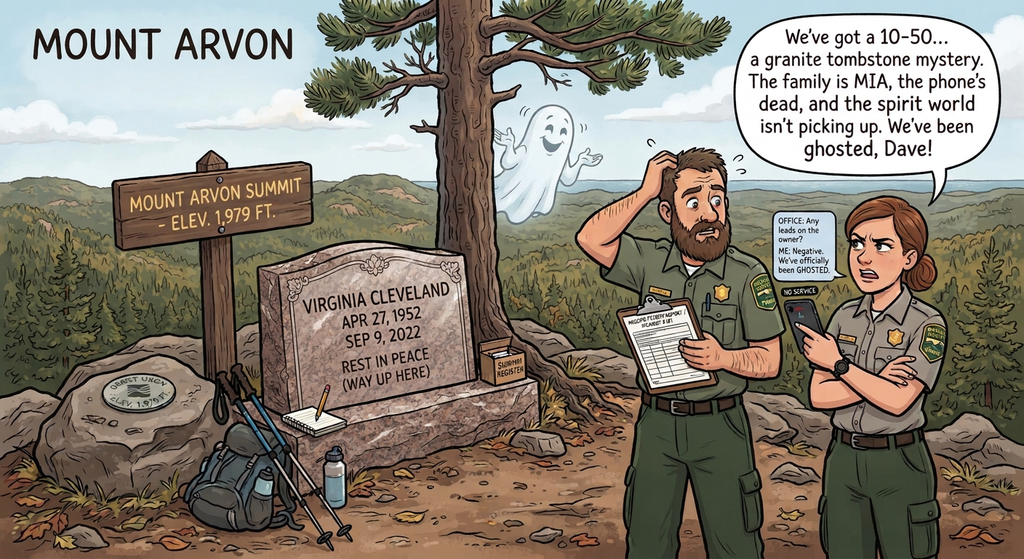
Authorities investigating how a granite grave marker on Mount Arvon wound up on the summit have reached a dead end, and they have been ghosted.
Jokes about grave stones and memorials appearing on Mount Arvon
- Highpointers are getting intense. Getting to the top of Michigan’s highest peak used to mean signing a logbook; now people are trying to lease a plot.
- Lyme Great Lakes Timberlands is getting worried. If they don’t stop the trend now, by next summer the summit registry will be replaced by a directory of loved ones.
- You know a hike is steep when the summit decor is a reminder of mortality. It really adds a whole new meaning to “feeling dead tired” at the top.
- Hikers arrive at the peak looking for the benchmark, only to find they have accidentally stumbled into the highest real estate market in the Upper Peninsula.
- Local officials are still trying to track down the family. They want to ask how they managed to carry a heavy granite tombstone all the way up those rugged logging roads without destroying their truck’s suspension.
Granite Gravestone Reported on Summit in May 2025
The gravestone found on Mount Arvon is not an actual burial site, but an unauthorized memorial marker placed under a tree for a woman named Virginia Cleveland (April 27, 1952 – September 9, 2022). [1]
Key Facts About the Marker
The unauthorized marker found tucked beneath a tree at the summit of Mount Arvon was a professionally crafted light-gray granite headstone. It featured clear, traditional sandblasted typography framed by an elegant ornamental accent border engraved at the top. [1]
The exact inscription on the face of the stone read: [1, 2]
VIRGINIA CLEVELAND
APR 27, 1952
SEP 9, 2022
LOVING MOTHER
While it physically resembled a traditional upright headstone you would see in a formal cemetery lawn, it lacked a secured concrete base or footer and was simply placed upright on the ground at the remote peak. [1]
- The Public Discovery: Outdoors life reporter Laura Herberg discovered the stone on May 17, 2025, while hiking the peak for a Bridge Michigan “Michigan Dreaming” bucket list series. [1, 2]
- The Placement Timeline: According to local officials with the Baraga County Convention & Visitor’s Bureau, the Virginia Cleveland stone was one of three or four unauthorized memorial markers that visitors had quietly left at the summit over the course of 2024. [1]
- Who is Virginia Cleveland? Legacy.com lists a Virginia Cleveland from Jackson, Mississippi, with those specific dates, but there are no other details. Public records and newspaper searches show no known ties or history connecting her to Michigan. [1]
- No Burial on Site: Local authorities, including the Baraga County Convention & Visitor’s Bureau, confirmed that no one is actually buried at the summit of Mount Arvon. [1]
- Unauthorized Placement: According to local management and land representatives, several memorial markers and unauthorized items were left on the peak by visitors. The private land company requested that these unauthorized markers be removed. [1]
- Common Practice: Leaving ashes, mementos, or temporary memorial markers at the top of Michigan’s highest point has occasionally occurred despite lacking official permission from landowners.
Lyme Great Lake Timberlands Policy on Unauthorized Markers
The private owner of the land, Lyme Great Lakes Timberlands, issued a request for all unauthorized memorial markers to be removed from the summit. [1]
However, rather than immediately disposing of the stone, local officials took a more measured approach to respect potential family members:
- The Mandate: Because Mount Arvon is actively managed commercial forestland, the timber company explicitly requested that the memorial sites be cleared to prevent the peak from becoming an unregulated, informal cemetery. [1]
- The Search for Family: To handle the situation respectfully, local tourism official Mary McEwen (from the Baraga County Convention & Visitors Bureau) stepped in to try and locate Virginia Cleveland’s surviving family members. The goal was for the family to retrieve the marker themselves rather than have it unceremoniously taken away by land management. [1]
- The Current Dilemma: Finding the family proved highly difficult. Since the stone’s public discovery, outreach efforts have had no luck connecting with anyone responsible for placing the marker at the peak.
Lyme Great Lakes Timberland History
Lyme Great Lakes Timberlands is the largest private forestland owner in the Upper Peninsula of Michigan and northeastern Wisconsin. [1, 2]
The entity operates as a regional portfolio property of The Lyme Timber Company, a prominent timberland investment management firm based in Hanover, New Hampshire. [1, 2, 3, 4]
Lyme entered the Great Lakes market in late 2019 by executing a massive $300 million cash purchase of roughly 555,000 acres from Weyerhaeuser, eventually expanding its footprint to over 600,000 contiguous acres spanning 13 Michigan counties and 3 Wisconsin counties. [1, 2, 3]
- The Local Team: The land is managed on the ground by Lyme Great Lakes Forest Management LLC, which operates distinct district offices out of Escanaba and L’Anse, Michigan. [1, 2, 3]
- The “Working Forest” Model: Unlike traditional corporate loggers or strict environmental reserves, Lyme specializes in combining sustainable commercial timber harvesting (primarily high-quality sugar maple and various hardwoods/softwoods) with high-profile conservation projects. [1, 2]
- Massive Scale: They are the private landowning force behind historic state agreements, such as the 73,000-acre Michigamme Highlands easement and the massive 152,000-acre Great Lakes Basin project—which guarantee the land remains open to the public for hunting, fishing, and trail riding while protecting it from real estate development. [1]
Origin of the Name
The name is a straightforward combination of the parent company’s geographical roots and its 2019 expansion zone.
- “Lyme”: This stems directly from Lyme, New Hampshire, the small town located immediately north of Hanover along the Connecticut River. The Lyme Timber Company was originally founded in this immediate area in 1976 and historically drew its identity from the local Upper Valley landscape. [1, 2]
- “Great Lakes”: This descriptor was added to differentiate this massive chunk of acreage from the company’s other major regional holdings, such as the Lyme Adirondack Forest Company in New York or Mountaineer Forest Management in West Virginia. [1]
- “Timberlands”: Standard industry nomenclature referencing large tracts of forested land primarily managed for wood production and ecosystem services. [1]
People Scatter Ashes of Pets and People on Summits
While the specific names or text on the other markers have never been publicly detailed in local news or reports, regional tourism and land representatives noted that three or four separate spots had been set up at the summit. [1]
The items quietly left at the peak followed a common pattern found at high-altitude or remote geographical landmarks:
- Pet Memorials: Small stone plaques or markers dedicated to family pets that passed away.
- Scattered Ashes Sites: Temporary markers, small piles of rocks (cairns), or wooden crosses marking where the cremated remains of loved ones were spread.
- Highpointer Keepsakes: Small trinkets, tokens, or custom-engraved rocks left behind by “peakbaggers” who celebrate reaching Michigan’s highest point.
Because the peak lies on commercial property managed by a private land company, officials had to request the removal of all these personalized memorial sites to maintain the natural landscape and prevent the summit from inadvertently becoming an unregulated cemetery. [1]
The mountain has a long history of corporate timber ownership and has changed hands several times over the decades, previously belonging to other major forest product companies like MeadWestvaco, Plum Creek, and Weyerhaeuser. [1, 2]
The Michigamme Highlands Conservation Easement
While the land is privately owned and actively managed for sustainable logging, public recreational access to the summit is permanently protected. [1, 2]
- The Partnership: In 2026, Lyme Great Lakes Timberlands finalized a massive, permanent working forest conservation easement with the Michigan Department of Natural Resources (DNR). [1, 2]
- The Scope: The deal covers over 73,000 acres in the Michigamme Highlands across Baraga, Marquette, and Iron counties. [1]
- What It Means for Visitors: Because of this easement, the public is legally guaranteed access to hike, snowmobile, fish, and visit the peak of Mount Arvon. The land continues to operate as a private working forest, meaning you are driving on active commercial logging roads to get there, but the scenic summit views are protected from real estate development in perpetuity.
The Michigamme Highlands Conservation project refers to a massive 73,000-acre working forest conservation easement located in the rugged western Upper Peninsula of Michigan, legally finalized in March 2026. [1, 2]
Spanning Baraga, Iron, and Marquette counties, it represents one of the largest land conservation achievements in Great Lakes history. [1, 2]
What is the Michigamme Highlands Conservation Project?
The project is a unique public-private partnership between The Lyme Timber Company (the landowner) and the Michigan Department of Natural Resources (DNR). [1]
- The Arrangement: The Michigan DNR holds the permanent easement. Lyme Timber retains private ownership of the land to continue sustainable commercial logging, keeping local forestry jobs active. [1, 2, 3]
- Ecological Protection: The easement permanently bans the land from being divided or developed. It protects Mount Arvon (Michigan’s highest natural point), over 13,600 acres of wetlands, 37 miles of rivers, and critical winter habitat for white-tailed deer and moose. [1, 2, 3, 4]
- Public Recreation: It secures permanent public access for hunting, fishing, kayaking, hiking, and over 140 miles of trails for snowmobiling, ORVs, and biking. [1, 2]
Origin of the Michigamme Name
The name “Michigamme” shares the exact same Indigenous linguistic roots as the state name “Michigan”. [1]
- The Indigenous Root: It is derived from the Ojibwe (Anishinaabe) word mishigami.
- The Meaning: The word translates directly to “great water,” “large lake,” or “middle large sea.”
- How it Spread: Centuries ago, Native communities used the phrase to describe the region’s vast bodies of water. Early French explorers and mapmakers recorded the word phonetically as Michigami or Michigama. Over time, it became anglicized and standardized to map Lake Michigamme and its surrounding mountainous highlands in the Upper Peninsula. [1, 2, 3]