
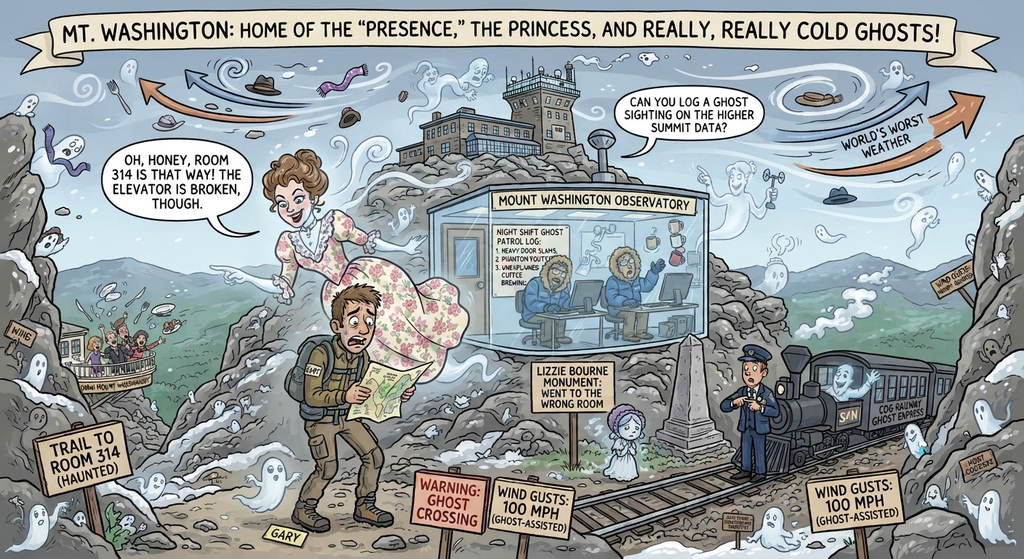
Mount Washington is widely considered one of the most haunted locations in New England. Because the mountain has claimed over 160 lives due to its notoriously extreme, erratic weather and avalanches, ghost lore spans from the base to its 6,288-foot summit. [1, 2, 3, 4]
Jokes
Lizzie Bourne
- Lizzie Bourne famously passed away just a few hundred yards from the summit house in 1855. Today, her ghost is rumored to haunt the tracks, mostly asking hikers, “Wait, you mean to tell me the shelter was right over there the whole time? I want a refund on this centuries-old haunting.”
- Hikers resting near the monument occasionally claim to hear soft, phantom whispers in the fog. It’s usually Lizzie’s spirit looking over their shoulders and muttering, “Seriously? You wore canvas sneakers up here? Even I knew better than that in a crinoline skirt.”
- The stone monument dedicated to Lizzie sits right along the Cog Railway. Passengers say her spirit looks incredibly peaceful, except for when the train goes by at four miles per hour and she has to listen to the exact same historical speech over the PA system twenty times a day.
- Lizzie Bourne’s ghost has a very specific haunting style. Instead of rattling chains, she just stands in the freezing mist and passive-aggressively judges the multi-million-dollar high-tech Gore-Tex gear of modern hikers who are still complaining about a light breeze.
- If you hear a low, mournful wail near the summit, it isn’t Lizzie crying over her tragic fate. It’s just her watching a TikTok influencer try to film a dance routine on a jagged granite boulder in a 70 MPH gale.
- The ultimate irony of the Lizzie Bourne haunting is that she perished from exposure right before the summit house was completed. Today, her spirit’s main job is convincing shivering tourists that the $10 bowl of summit cafeteria chili is actually worth the supernatural price tag.
Extreme Weather
- Mount Washington ghosts don’t actually rattle chains. They just stand outside shaking frozen trail markers because it’s the only way to get a tourist’s attention in a 140 MPH whiteout.
- The spirits on the summit don’t try to scare you by turning the lights off. They try to scare you by turning the thermostat down to minus forty, which honestly feels exactly the same as the regular weather.
- You know you’re dealing with a Mount Washington ghost when it tries to walk through a solid wall but gets completely blown into coastal Maine by a sudden northwest gust instead.
The Princess & Mount Washington Hotel Room 314
- The Ghost of the Princess is famous for mysteriously filling up the bathtub in Room 314. Hotel staff say it’s a supernatural manifestation; guests say it’s just her trying to thaw out after spending five minutes on the Observation Deck.
- A guest in Room 314 reportedly complained about hearing a phantom brushing hair at the foot of the bed. The hotel manager politely reminded them, “Ma’am, with the wind shear out here, untangling that hair is a multi-generational task.”
- The elevators at the Omni Mount Washington Resort are famous for moving between floors with no passengers. It’s not a haunting—it’s just local ghosts trying to get an indoor workout because the wind chill outside is too brutal for ectoplasm.
The Summit Observatory Crew
- The Weather Log:
- 02:00 AM: Wind speed: 95 MPH. Visibility: Zero.
- 02:15 AM: Loud, disembodied footsteps marching through the kitchen. Doorknobs rattling violently. Heavy slamming sounds coming from the generator room.
- 02:20 AM: Logged as: “Slight draft in the northeast corridor. Recommend checking the weather stripping in May.”
- The meteorologists on the night shift don’t even flinch when “The Presence” slams a heavy steel door anymore. They just yell, “Close it all the way, Gary! We aren’t paying to heat the entire Presidential Range!”
Hiking Trails
- Hikers resting near the Lizzie Bourne monument often claim to hear low, disembodied wailing cutting through the fog. Park rangers assure everyone it’s just the sound of out-of-shape tourists realizing they still have three miles of relentless granite boulders left to climb.
- The ghosts at the Lakes of the Clouds Hut don’t haunt the kitchen to steal food. They are just trying to steal a dry pair of wool socks because their ectoplasm has been thoroughly soaked by a freezing alpine bog.
- You know you’ve been hiking Mount Washington too long when you see a spectral apparition floating above the trail and your first thought isn’t “Oh no, a ghost!” but rather “Man, I wish I could float over these rock piles to save my knees.”
- The true horror story of Huntington Ravine isn’t a phantom. It’s the terrifying realization that you have reached a vertical rock scramble, your hands are completely numb, and you didn’t pack nearly enough Snickers bars for the ascent.
Lizze Bourne Story
The story of Lizzie Bourne is one of the most famous and foundational tragedies in the history of Mount Washington. In September 1855, she became the first woman known to perish on the mountain, and her death deeply influenced how the public viewed the dangers of the Presidential Range.
The Ill-Fated Hike
On the afternoon of September 13, 1855, 23-year-old Lizzie Bourne of Kennebunk, Maine, set out to hike the Glen House bridle path to the summit. She was accompanied by her cousin, Lucy Bourne, and her uncle, George Bourne.
- The Goal: The trio wanted to see the newly constructed Tip-Top House, a stone hotel at the 6,288-foot summit.
- The Mistake: They started their ascent incredibly late in the day, around 2:00 PM. They were unguided, lacked proper cold-weather gear, and underestimated how quickly Mount Washington’s weather can turn lethal.
- The Storm: As they neared the upper alpine zone, a dense fog rolled in, followed by fierce gales, freezing rain, and a rapid drop in temperature. Disoriented by the blinding mist and darkness, they lost sight of the trail.
A Tragedy of Yards
Exhausted, freezing, and unable to find the path, George Bourne realized they could no longer ascend or safely retreat. He constructed a crude windbreak out of loose granite boulders to shield the two young women from the howling winds. The three huddled together through the grueling, freezing night.
Tragically, Lizzie passed away from hypothermia in her uncle’s arms just hours before dawn.
When the sun rose and the storm cleared the next morning, the surviving cousins suffered a heartbreaking revelation: they had spent the night just 300 feet (about 100 yards) from the summit house. Had they been able to see through the fog for just a few more steps, they would have found safety, warmth, and shelter.
The Monument & Legacy
Lizzie’s body was carried down the mountain by railway workers and returned to Maine. To commemorate the tragedy, a prominent stone monument was erected at the exact location where she died, positioned right along the tracks of the Mount Washington Cog Railway.
For over a century, passengers riding the Cog Railway have looked out their windows to view the monument. Her tragic story served as a stark, early warning to early American tourists that Mount Washington—despite its accessibility—demands absolute respect, proper planning, and winter gear even in the late summer.
Princess and Room 314
The story of The Princess and Room 314 is the crown jewel of the Omni Mount Washington Resort’s paranormal lore in Bretton Woods, New Hampshire. It revolves around the life, luxury, and lingering presence of Carolyn Stickney, the wealthy wife of the resort’s builder.
Who Was “The Princess”?
In the late 1890s, New York coal magnate Joseph Stickney set out to build the most luxurious Gilded Age grand resort in the White Mountains. His wife, Carolyn, was deeply involved in the design, choosing lavish furnishings and extravagant decor.
- A Brief Reign: The hotel opened to roaring success in 1902. Tragically, Joseph Stickney died just a year later in December 1903, leaving his massive fortune and the grand hotel entirely to Carolyn.
- Becoming Royalty: Carolyn spent her newfound wealth traveling Europe, where she eventually met and married a French nobleman, Prince Jean Baptiste Marie de Faucigny-Lucinge, in 1914. This union earned her the lifelong title of “The Princess.”
- An Enduring Love: Despite her royal life abroad, Carolyn’s true love remained the grand hotel in New Hampshire. She returned every single summer to host elite high-society parties, occupying a private, multi-room luxury suite on the third floor until her death in 1936.
The Hauntings of Room 314
Today, Carolyn’s former private sanctuary is designated Room 314 (formerly Room 206) and is widely considered one of the most active haunted hotel rooms in America. Guests who stay in the room, as well as the resort’s staff, frequently report a series of consistent, elegant manifestations:
- The Woman at the Bed: The most famous phenomenon involves guests waking up in the middle of the night to see a spectral woman in a Victorian gown sitting at the edge of the bed. She is almost always described as calmly brushing her long hair.
- The Four-Poster Bed: The bed currently in Room 314 is the exact, hand-carved maple four-poster bed that belonged to Carolyn herself. Guests often report seeing the distinct physical impression of someone sitting or lying on the mattress when the room is otherwise empty.
- Sudden Scents & Splashes: Visitors frequently note the sudden, overwhelming scent of a vintage floral perfume drifting through the air. Others have walked into the bathroom to find the vintage bathtub mysteriously filling up with warm water on its own.
Beyond the Room
The Princess’s presence is felt far beyond the walls of Suite 314. The hotel staff keeps her legacy alive with several unique traditions and observed quirks:
- The Royal Table: In the hotel’s grand dining room, a specific table near the window—Carolyn’s favorite vantage point for viewing the mountains—is permanently set in her honor every evening. Staff members have occasionally reported finding the silverware subtly shifted out of place after hours.
- The Grand Staircase: Guests walking down the main staircase near the lobby sometimes report a sudden drop in temperature accompanied by a elegant, white mist floating down the steps ahead of them.
While skeptics look at the hotel’s sprawling wooden framework and century-old electrical wiring to explain away the flickering lights and phantom footsteps, Room 314 remains a highly sought-after booking for ghost hunters and history lovers alike.
Caketake George at Lake of the Cloud AMC Hut
The chilling story of George at the Lakes of the Clouds Hut is one of the most famous and unsettling tales recounted by the Appalachian Mountain Club (AMC) “Croo” members. The story is traditionally featured in Marianne O’Connor’s book, Haunted Hikes of New Hampshire.
The Solo Caretaker
During the early years of the AMC, a young crew member named George was tasked with hiking up Mount Washington alone in the late spring to assess the winter damage and prepare the Lakes of the Clouds Hut for the upcoming hiking season. The hut sat in a high alpine saddle, completely boarded up with heavy wooden shutters to protect it from the punishing winter elements. [1, 2, 3]
George safely reached the hut, set his gear down, and unlocked the heavy padlocked door. Tired from the strenuous trek, he sat down at a table in the dim, windowless dining hall to eat a quick meal before radioing down to the base to report his status. [1]
The Faces in the Glass
While eating in the pitch-black room, George suddenly felt an intense drop in temperature and the overwhelming sensation that he was no longer alone. He felt an unseen entity approach him from behind, as if it were about to place its cold hands right onto his shoulders. [1, 2]
Terrified, George spun around. Looking toward the boarded-up windows, he saw a grotesque, distorted human face staring directly at him. The face was impossibly trapped between the outer protective winter boards and the inner window glass. [1, 2]
As George panicked, the visage began multiplying, jumping from one window pane to the next. In some versions of the lore, a whole crowd of leering ghouls filled every single window of the hut. Then, the main face did something truly horrifying: it began to visually melt straight through the solid glass and float directly into the room toward him. [1, 2, 3, 4]
The Discovery
Down at the base station, the AMC crew grew deeply concerned when George failed to check in over the radio. The next day, a rescue party hiked up the mountain to find the hut locked from the inside. [1]
They breached the door and found George’s radio sitting on the dining table, perfectly operational. After scouring the building, they opened the wooden cupboard doors underneath the kitchen sink. [1, 2]
George was found curled into a ball, sweating profusely, whimpering in total shock, and clutching an axe (or butcher knives, in older versions of the lore) to protect himself. He was entirely unresponsive to his friends’ voices. [1, 2, 3]
The crew immediately evacuated George down the trail to a waiting ambulance. It took weeks of hospitalization before he was lucid enough to recount what he had witnessed in the dark. While the physical shock eventually passed, George reportedly suffered from permanent trauma and severe memory gaps regarding the rest of that night. [1, 2, 3]
In the broader tapestry of Mount Washington folklore, the transition of George from a living witness to a ghostly fixture of the hut boils down to how his story evolved over generations of Appalachian Mountain Club (AMC) oral tradition. [1]
While the real, historical George survived his ordeal and left the mountain vowed never to return, he is said to “haunt” the spot in two distinct ways: [1]
The Lore Trapped Him There
In the decades following the incident, the story became a staple campfire tale told to new AMC “Croo” members and hikers staying at the Lakes of the Clouds Hut. Over time, listeners began conflating the victim of the haunting with the haunting itself. Because the story ends with George completely frozen in terror under the kitchen sink, superstitious hikers started claiming that a piece of his panicked, residual energy remained trapped in that very kitchen cabinet forever. [1, 2]
Confusion with William Curtis (in 1900 tragedy)
The actual entity that allegedly terrified George is widely believed by local ghost hunters to be William Curtis. In June 1900, Curtis and his hiking partner, Allan Ormsbee, tragically perished from hypothermia in a freak summer snowstorm in the exact alpine saddle where the hut now stands. The Lakes of the Clouds Hut was originally built as a tiny emergency shelter in 1901 precisely because of their deaths. [1, 2, 3]
Because “George” is a much catchier name for a resident ghost than “William,” casual storytellers over the last century combined the elements: they took the tragic location of Curtis’s death and mixed it with George’s terrifying experience, ultimately turning “George the Caretaker” into the catch-all nickname for the phantom entity people still claim to encounter in the building today.