
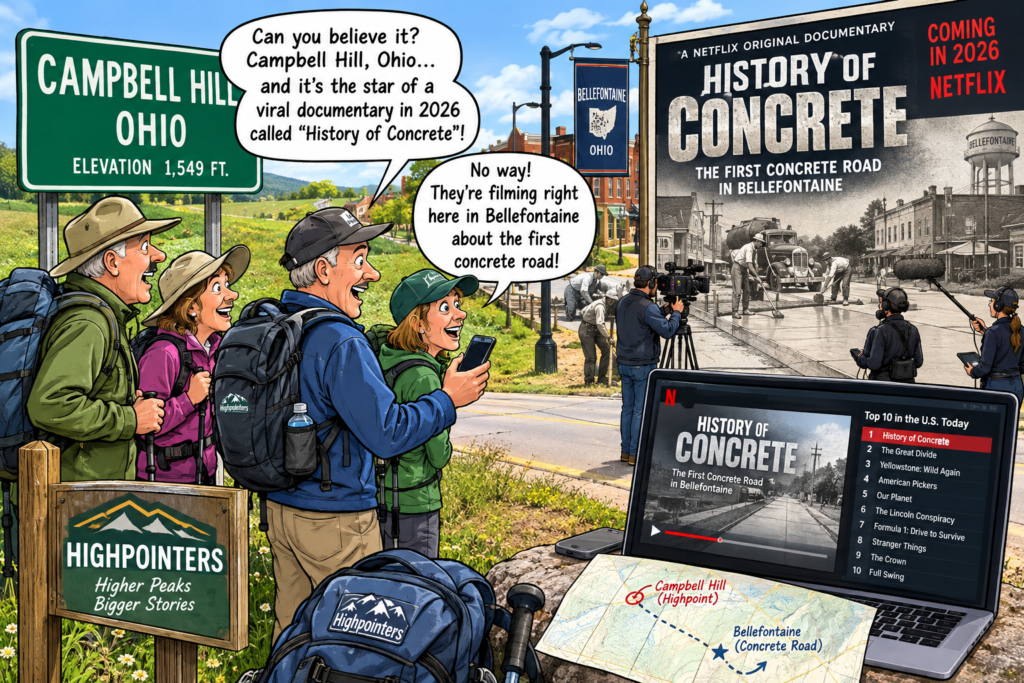
John Wilson’s viral comedic “rockumentary” The History of Concrete (2026) includes a visit to Campbell Hill while visiting the area around Bellefontaine’s first concrete street in the United States. Wilson’s deadpan humor involves going off on tangents, initially based on a search for the history of something. I will go into a deeper dive after the jokes.
- Highpointers came to Bellefontaine for Campbell Hill, but the “first concrete street” sign stopped them in their tracks. They’d climbed the highpoint—then got stuck on the pavement.
- They watched A History of Concrete and came to see the famous street. By the end, they were still there—just cemented to the spot.
- A Highpointer’s itinerary: reach Ohio’s highest point, visit America’s first concrete street, then spend the rest of the day trying to decide which one was the bigger peak experience.
- They came for Campbell Hill, saw the concrete street, and immediately changed their motto from “Find the highpoints” to “Find the hard points.”
- The highpoint was a quick stop. The concrete street was the real draw—those visitors really know how to raise the bar and lower the road.
- After A History of Concrete, Highpointers started rating roads by elevation, age, and likelihood of leaving a lasting impression.
- “We’re here to see Ohio’s highest point,” they told the locals. “Great,” said the locals. “And while you’re here, we’ll show you something truly groundbreaking: a street that’s been set in stone.”
- Highpointers usually chase summits. In Bellefontaine, they found a street that’s been holding its ground for over a century.
Context
In John Wilson’s documentary The History of Concrete (2026), the humor comes from deadpan, mundane observations, bizarre narrative left turns, and everyday human eccentricities.
The Bellefontaine, Ohio Sequence
- The Driving Lesson Detour: Wilson visits Bellefontaine, Ohio—home to the first concrete street in the U.S. (Court Avenue) and Campbell Hill, Ohio’s highest point.
The Pun & The Pacing: In the documentary, Wilson sits in on a local driving lesson that drives over the historic concrete road. The instructor mentions that relatives of people killed in car accidents sometimes visit the classes to drive home—pun intended—safety points. - The Bizarre Cut: True to Wilson’s signature style (reminiscent of How To with John Wilson), the very next shot cuts to an urn in a living room, leading into an interview with a woman whose husband died in a crash, and a deep-dive interview with a company called Save My Ink Forever that preserves tattoos from deceased people’s skin.
Style of Humor
- Absurd Association: Wilson connects dry, structural infrastructure history (like 1890s cement mixing or Ohio highpoints) with completely unrelated, deeply personal, or macabre modern subcultures.
- The “Rockumentary” Premise: The film frames itself as an awkward, mock-earnest attempt to turn a documentary about concrete into a commercial, Hallmark-style, or music-driven project to secure funding.
- Deadpan Realism: Rather than mocking his subjects, Wilson lets everyday people talk about their hyper-specific passions or tragedies with total sincerity, creating comedy out of the sheer contrast of human life.