
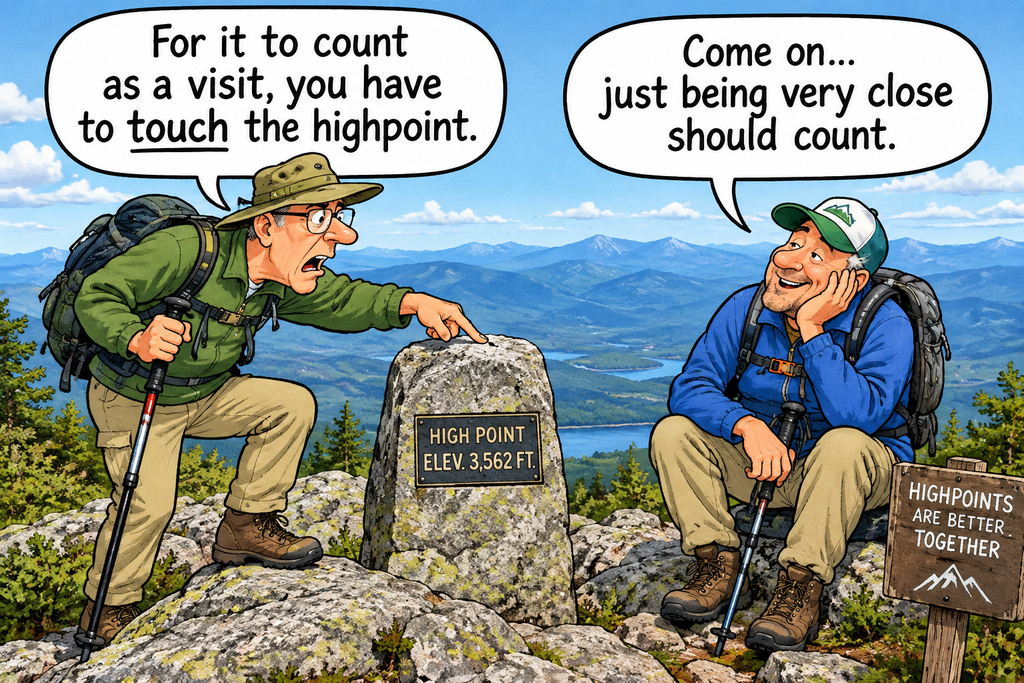
Whether saying you visited a highpoint requires touching the exact highest peak depends entirely on your personal goals and the specific community you are engaging with. Within the peakbagging and highpointing communities, opinions vary between strict traditionalists and more casual hikers.
- Highpointers argue about whether proximity counts—it’s a very fine point.
- “I touched the highpoint.” “With what?” “My GPS signal.”
- I didn’t reach the summit; I reached an understanding with it.
- Some highpointers summit. Others just summit the debate.
- I was so close to the highpoint, we were practically on speaking terms.
- “Did you touch it?” “No, but my shadow did.”
- I visited the highpoint’s personal space.
- Close enough to count, far enough to argue.
- My highpoint visit was technically adjacent.
- The highpoint was there; I was there. The lawyer says that’s a meeting.
- I didn’t miss the highpoint—I narrowly avoided making contact.
- The summit’s touchy about the definition of “visit.”
- I got within a hair’s breadth of the highpoint. It was a very elevated hair.
- “Did you summit?” “I don’t want to peak too soon.”
We settled the debate by flipping a coin—right onto the highpoint.
The Perspectives
- The Strict Perspective (The Traditionalists): For many dedicated highpointers, reaching the true summit is the entire objective. In this view, if there is a specific USGS benchmark, boulder, or monument marking the absolute highest point of elevation, you have not officially “bagged” the highpoint until you have stood on or touched it. For some, being 5 feet away or stopping at a viewing platform just below the true peak counts as a near-miss rather than a completion.
- The Practical Perspective (The Casual Hikers): Most general outdoor enthusiasts consider arriving at the summit area, observation deck, or designated trail terminus to be a successful visit to the highpoint. If safety concerns, deep snow, dense brush, or official barriers prevent you from touching the exact square inch of the peak, forcing the issue can be seen as unnecessary or dangerous.
Context Matters
The definition of a successful visit often depends on the specific geography of the highpoint:
- Distinct Peaks: On a clear, rocky peak like Mount Washington (New Hampshire) or Mount Whitney (California), finding and touching the exact highpoint is straightforward and generally expected.
- Flat Summits: On broad, forested highpoints like Ebright Azimuth (Delaware) or Hoosier Hill (Indiana), the true highpoint might be a subtle bump in a flat field or someone’s backyard. In these cases, reaching the general marker or register is widely accepted as a successful visit.
Ultimately, highpointing is a self-governed hobby with no official referee. If you are tracking your progress for personal satisfaction, you can set your own rules. However, if you are submitting completions to official clubs (such as the Highpointers Club), it is best to get as close as safely and legally possible to the actual geological highpoint.