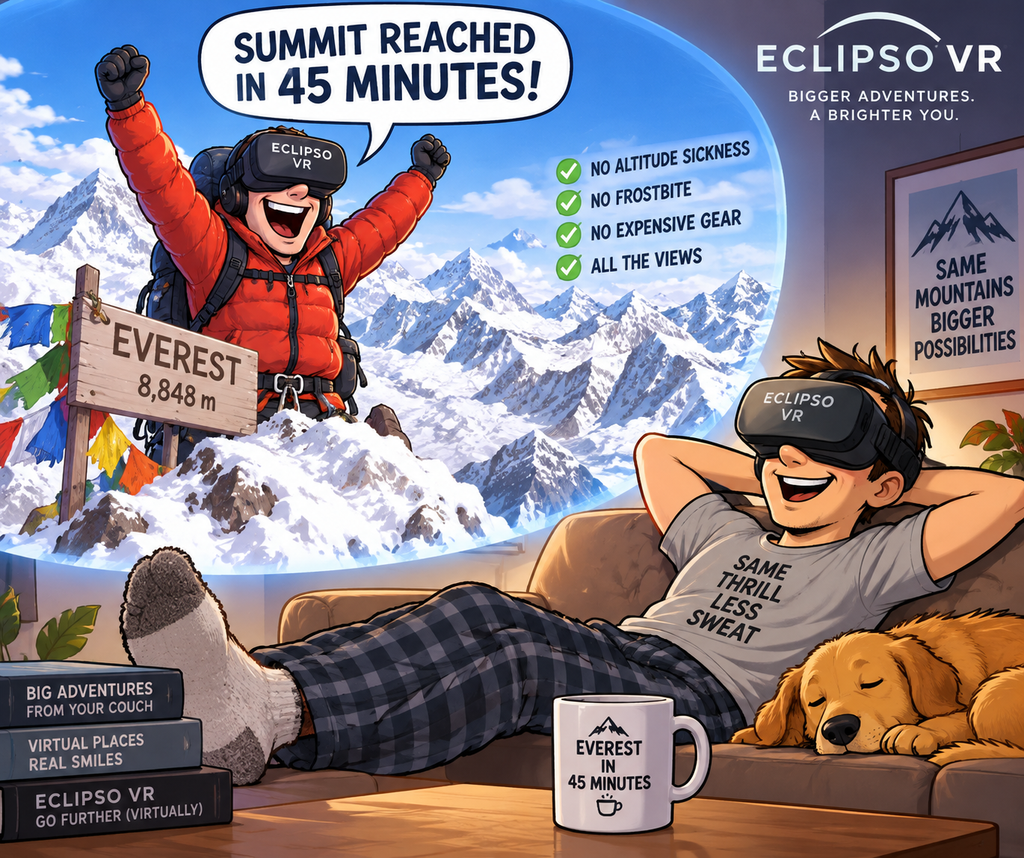
The Everest: The First Ascent VR experience at Eclipso is an immersive, free-roam virtual reality journey that recreates the historic 1953 British Mount Everest expedition led by John Hunt, where Edmund Hillary and Tenzing Norgay (alongside their Sherpa team) became the first climbers to reach the summit.
Humorous Overview of Eclipso’s VR Everest Experience
Here are some one-liner jokes focusing on the specific absurdity of doing Eclipso’s “Everest: The First Ascent” VR experience—where people “summit” the world’s tallest mountain while wandering around a flat room in Manhattan or London:
The “Danger” of the Climb
- I tackled the Khumbu Icefall at Eclipso, and let me tell you, stepping on someone else’s VR cable is a long way down.
- The most life-threatening thing about climbing Everest in VR is walking blindly into a structural support pillar at 555 West 57th Street.
- My Sherpa guide at Eclipso was great, but he looked exactly like an underpaid 22-year-old theater major named Tyler.
- I almost got frostbite on the virtual summit, but then the staff adjusted the venue’s central air conditioning.
- They said the altitude sickness at Eclipso would be brutal, but it turns out they just meant the dizziness from spinning in circles while wearing an Oculus headset.
The Logistics
- I finally scaled Mount Everest without a single oxygen tank, mostly because the air quality inside an air-conditioned room in Manhattan is already pretty stable.
- The Eclipso Everest expedition is a true test of human endurance—if you can survive finding parking near Columbus Circle, the 29,000-foot peak is a breeze.
- My friends asked if I encountered any frozen bodies on the Death Zone route, and I said, “Yeah, a couple of people whose headsets glitched during the briefing”.
- I climbed all the way to the top of the world alongside Edmund Hillary, and all it cost me was 31 dollars and a 45-minute chunk of my afternoon.
Key Details and History
- Subject Matter: The experience retraces the 1953 expedition from Kathmandu through Sherpa culture, high-altitude camps, and glaciers all the way to the peak, commemorating the historic climb (the news of which famously reached London on June 2, 1953, the morning of Queen Elizabeth II’s coronation). [1, 2]
- Format & Experience: It is a free-roam VR experience where participants stand and move together on a dedicated physical platform without cables or hand controllers. The total on-site duration is around 40 to 45 minutes (including a 10-minute briefing and a 35-minute active VR portion). Interactive elements include cultural touches like spinning prayer wheels or holding a cup of tea. [1, 2, 3, 4]
- Locations: The experience is featured across multiple international Eclipso centers and European cities (such as Paris, London, Barcelona, Bordeaux, and Dublin) as well as the United States. [1, 2]
- Eclipso New York: Launched on September 30, 2026, at Eclipso NYC (located at 555 West 57th Street, Manhattan)
How Eclipso Created the Experience
Recreating the massive scale and historical accuracy of the 1953 Mount Everest expedition for a location-based entertainment venue required a highly technical and collaborative production process. [1, 2]
Rather than just building a standard video game level, Eclipso combined deep historical research, expert consultation, and proprietary free-roam hardware to bring the experience to life. [1, 2]
Collaborative Historical & Scientific Research
To respect the culture and accurately portray the sheer difficulty of the 1953 climb, Eclipso did not rely purely on imagination. They collaborated directly with specialized scientific and cultural experts to ground the narrative: [1]
- Katia Buffetrille & Charlie Buffet: Provided critical geographic, historical, and mountaineering context regarding the 1953 British expedition’s route and logistics. [1]
- Lapka Sherpa Gelgen: Ensured that the portrayal of Himalayan landscapes, Nepalese traditions, and the crucial, central role of the Sherpa community was culturally accurate and respectful. [1, 2]
Free-Roam Spatial Mapping
Unlike at-home VR setups where users are stationary or confined to a tiny boundary, Eclipso utilizes a 450+ square meter physical tracking platform. [1, 2]
- Cable-Free Tracking: Developers engineered the environment so up to dozens of visitors can walk around simultaneously without tethered cables or handheld controllers. [1]
- Simulated Physical Geometry: The virtual high-altitude camps, bridges, and shifting glaciers are mapped perfectly to the flat physical floor, tricking the brain into feeling the terrifying vertigo of crossing a deep crevasse on a narrow ladder. [1, 2]
Interactive Mechanics Over Passive Viewing
To make it feel like an active expedition rather than just a 4D movie, the creators engineered specific environmental interaction loops:
- Tactile Interactions: Players can interact with objects without complex button mapping—using their hands naturally within the VR space to spin Tibetan prayer wheels or hold a hot cup of tea.
- Atmospheric Emulation: The narrative and visual effects are paced to simulate the crushing progression of altitude, lack of oxygen, and changing weather patterns as you move from the lush valley of Kathmandu up to the frozen, wind-swept Khumbu Icefall. [1, 2, 3, 4]
Next-Gen Hardware Optimization
Eclipso upgraded its venues with advanced, ultra-clear VR headsets featuring high-fidelity lenses. Because the experience relies heavily on grand, sweeping Himalayan vistas, the development team had to optimize massive, photorealistic textures of snowy mountain ranges to render seamlessly at a high framerate, minimizing motion sickness for casual users. [1, 2]
The development team paired meticulous, multi-stage narrative pacing with cutting-edge spatial audio to build a deep sense of progression and physical atmosphere.
The Audio Design: Crafting Atmospheric Tension
To make players forget they are walking around a flat room in a major city, the sound design—engineered by specialized audio studios Blanktone and Native Primes—plays a vital role in tricking the senses: [1]
- The Audio “Chill”: Long before you reach the snow, the audio landscape shifts from the lively, warm acoustic sounds of Kathmandu to a harsh, cold sonic environment. The ambient howling of localized wind and the sharp crunch of footsteps on hard ice are mixed so realistically that reviewers have noted it genuinely “sends a chill up the neck” without any physical drop in room temperature. [1]
- Character-Driven Perspective: Directors Jean Dellac and Benjamin Auriche intentionally placed Tenzing Norgay at the center of the narrative, voiced by Thomas Espinera. Instead of relying on a dry, detached narrator, his warm yet gritty voice guiding you through the headphones establishes a strong emotional connection, capturing the fear, solidary, and exhaustion of the team. [1, 2]
- Sonic Cues for Altitude: As players ascend through the different stages, the background audio subtly changes. The air sounds “thinner,” wind frequencies become sharper, and the inclusion of heavy, labored breathing audio reinforces the psychological toll of high-altitude oxygen starvation. [1]
The Journey: Stages of the Climb
The 35-to-40-minute active VR journey compresses a months-long historic expedition into a tightly paced, multi-stage structure: [1, 2]
- Cultural Roots in Kathmandu: The journey begins in Nepal, highlighting the stark class and logistical contrasts of the 1953 expedition. You walk alongside a herd of cattle into Kathmandu on foot while Edmund Hillary arrives via train through terraced rice fields. Players gather around a campfire, pick up tapers to light candles, and interact with traditional Tibetan prayer wheels. [1, 2]
- Arriving at Base Camp: As the team reaches the base of the mountain, the terrain opens into sweeping, photorealistic Himalayan vistas. Here, you get a sense of the sheer scale of the operation required to support the climbers and the Sherpas. [1, 2, 3]
- The Khumbu Icefall (The “Vertigo” Set Piece): This serves as the experience’s primary thrill segment. Players must cross massive, deep crevasses by walking across narrow, virtual ladder bridges strung between shifting glaciers. Because the floor is flat, your brain relies entirely on visual depth and the creaking of the metal ladders to gauge your fear of heights. Along the way, smaller interactions allow you to snap virtual icicles off the path. [1, 2]
- The Oxygen-Starved Final Slope: As you push past the high-altitude camps toward the peak, the visual and audio effects intentionally morph. To simulate extreme physical hardship, the developers used special visual effects that mimic how severe oxygen starvation narrows a climber’s peripheral vision into a tight tunnel. [1, 2]
- Standing on the Roof of the World: The experience culminates at the 8,848-meter summit. The claustrophobic tunnel vision clears, revealing an expansive 360-degree panoramic view of the Himalayas stretching for hundreds of miles beneath a blinding sunrise. [1, 2]
Technical Aspects
The technical backbone of Eclipso’s location-based virtual reality (LBVR) setup relies on an impressive shift away from older, clunky VR hardware. Instead of heavy backpack PCs, ceiling-tethered cables, and complex handheld controllers, Eclipso uses a highly optimized, enterprise-grade, standalone wireless ecosystem. [1]
The exact hardware stack that makes these high-throughput group expeditions possible consists of several distinct layers:
The Headsets: Enterprise Standalone Power
Eclipso predominantly standardizes its fleet on enterprise-grade all-in-one wireless headsets, such as the HTC VIVE Focus 3 and the newly introduced PICO 4 Ultra Enterprise. [1, 2, 3]
- No Heavy Backpacks: The headsets process the virtual world using powerful onboard mobile chipsets. Users wear only the headset—completely eliminating the need for players to strap uncomfortable 10-pound computer backpacks to their shoulders. [1, 2]
- Ultra-High Resolution Vistas: To effectively map the vast terrain of Mount Everest without jagged lines or blur, the lenses offer up to 5K combined resolution with wide 110- to 120-degree fields of view, ensuring sweeping mountain horizons look crisp and clear. [1, 2]
- Integrated Spatial Speakers: The sound isn’t delivered via isolating over-ear cups. Instead, integrated dual-driver open-back speakers sit just above the ears. This delivers localized 3D spatial audio (like a gust of wind roaring from your left) while still letting you hear the real-world voices of your teammates walking next to you. [1, 2]
Tracking Infrastructure: Multi-User Free-Roam Cohesion
The magic of stepping onto the icefall with 30 coworkers relies on a complex inside-out and outside-in tracking alignment over a 450+ square meter arena. [1]
- Infrared Location Grid: The perimeter of the open room is lined with specialized tracking sensors and anchor points. Each headset features multiple wide-angle tracking cameras on the front visage. The cameras track the environment, while the venue’s master server syncs the positional coordinates of every headset in real time. [1]
- Ghost Avatars: To ensure safety, the tracking system populates your teammates as glowing, ghost-like outlined digital avatars inside your view. If you get within a few feet of someone’s real-world body, safety grids appear, preventing accidental physical collisions. [1]
Pure Hand-Tracking (No Controllers)
For Everest: The First Ascent, Eclipso bypasses standard plastic gaming controllers entirely. [1]
- 26-Point Optical Tracking: The cameras built into the front of the headsets continuously scan the open air in front of the user. Advanced hand-tracking algorithms map 26 distinct joint points on your actual fingers and palms.
- Natural Interaction Loops: When you reach out to spin a prayer wheel or light a taper, the headset reads your real fingers closing or gripping. This eliminates the classic friction of a corporate event where non-technical attendees spend half the session looking for the right plastic trigger button. [1, 2]
Hygiene & Rapid Cycle Fleets
From an operational perspective, the physical design of the hardware is heavily modified for heavy public usage:
- Magnetic Swappable Cushions: The foam face gaskets and rear padding on the enterprise gear are fully magnetic. Between every 45-minute show block, staff can instantly pull the worn face-lining off, snap a sanitized replacement back on, and drop the used cushions into rapid UV disinfecting bays.
- Counterweighted Battery Straps: To prevent neck strain over a long session, the heavy battery pack is engineered directly into the rear curve of the head strap, balancing the weight of the front optical lenses equally across the skull. [1, 2]
Location-Based Entertainment (LBE)
In the location-based entertainment (LBE) industry, flagship experiences like Everest: The First Ascent are typically built using either Unreal Engine or Unity. These engines provide the massive graphical rendering pipelines and spatial calculations required to track dozens of users simultaneously in a shared physical environment. [1, 2]
The development team, led by Small Creative and Eclipso, relied heavily on specific real-time engine architectures to bridge the gap between historical accuracy and hardware performance: [1]
Photogrammetry and Nanite-Level Scaling
To build an environment that feels historically identical to the 1953 climb, developers use extensive stereophotogrammetric workflows. [1]
- Asset Ingestion: This involves compiling thousands of high-resolution archival photos, real-world satellite scans of the Himalayas, and topological mapping to build a dense 3D point cloud. [1]
- Unreal Engine Edge: Unreal Engine is historically the industry leader for handling this specific type of high-fidelity, real-world mesh data. Engines like Unreal utilize virtualized geometry pipelines (such as Nanite in UE5) to stream in billions of polygons seamlessly, allowing a player to stand at Base Camp and see miles of crisp mountain peaks without screen stutter that can induce motion sickness. [1]
Optimizing for Standalone Android VR
While the environment is designed with heavy cinematic assets, the final product must compile to run natively on mobile-based chipsets (such as the Snapdragon XR2 in the PICO 4 Ultra Enterprise headsets). [1]
- The Unity Advantage: Unity has traditionally been the gold standard for deploying highly optimized, standalone Android-based VR.
- Baking and Draw Calls: Regardless of the engine choice, developers must aggressively perform light baking (calculating all the shadows and sun bounce beforehand so the headset doesn’t have to compute them in real-time) and merge textures to keep “draw calls” minimal, ensuring the experience locks onto a flawless, motion-sick-free framerate.
Multiplayer Networking and Local Anchor Spatials
Traditional video games rely on client-server networks over long distances, whereas an Eclipso arena requires massive local-area multiplayer synchronization.
- Zero Latency Tracking: The engine must interface directly with Eclipso’s tracking software. It translates the real-world centimeter-level movements of 30+ physical bodies into matching coordinate planes inside the engine world.
- Network Replication: Custom server plug-ins within the engine continuously replicate the exact location, hand positions, and orientation of every player across all headsets over high-speed local Wi-Fi 6E/7 networks, ensuring your teammate’s “ghost avatar” is precisely where their physical body stands.
Reviews
Public reception for Everest: The First Ascent at Eclipso NYC and its international venues is highly positive, averaging around 4.6 out of 5 stars across ticketing and travel platforms. [1, 2]
Attendees generally praise the cutting-edge tech and historical depth, though as with any cutting-edge hardware installation, a few users encounter technical friction.
What Reviewers Love (The Pros)
- Genuine Sensation of Vertigo: The “Khumbu Icefall” ladder crossing is a massive highlight. Reviewers consistently note that, even though they know they are on a flat floor in Midtown Manhattan, the visual tracking tricks their brains into a racing pulse and genuine fear of heights. [1, 2]
- Cultural and Educational Value: Visitors appreciate that it isn’t a mindless arcade game. The integration of historical facts, the direct involvement of Sherpa consultants, and the start of the journey in Kathmandu give it an educational, almost spiritual weight. [1, 2]
- Social and Natural Flow: Because it is completely untethered, groups love being able to wander around together, chat naturally, and see their colleagues or family members mapped within the environment. [1, 2]
Common Criticisms & What to Watch For (The Cons)
- Occasional Hardware Hiccups: A few reviewers have noted occasional headset tracking issues or distorted visual floors that required staff intervention, which can break the deep psychological immersion. [1]
- Physical Intensity/Vertigo: Because the simulation of high-altitude heights is so convincing, it is actively discouraged for anyone prone to extreme vertigo, motion sickness, or heart/balance conditions. [1, 2]
- Price Point: Standard adult tickets range from $38 to $42 (plus a $3.95 booking fee). A few visitors felt the 35-minute active run time was slightly too short for the premium price tag, though New York residents can access a discounted local rate (~$34) to offset the cost.
How the VR Story Condenses the Climb
To condense a grueling two-month expedition into a 35- to 40-minute active VR journey, the creators of Everest: The First Ascent had to abandon the logic of standard video games and adopt the pacing techniques of cinematic time compression and spatial focal points.
Rather than forcing you to trek every tedious mile, the experience utilizes several distinct design strategies to warp time while preserving the emotional weight of the climb:
Spatial Teleportation via “Fade to Black” Transitions
The engine doesn’t make you walk the literal distance between camps, which would take days. Instead, it uses geographic snapshots.
- The Narrative Anchor: You complete a highly interactive, self-contained scene in a single location (such as spinning prayer wheels in Kathmandu or crossing a specific ladder at the Khumbu Icefall).
- The Cinematic Jump: Once the objective or emotional beat of that zone is met, the engine smoothly fades the environment out. The voice narration of Tenzing Norgay bridges the time gap, explaining the days of grueling trekking that occurred in between, before fading back in to place you instantly at the next major physical milestone.
Environmental Pacing & Sensory Acceleration
To make 40 minutes feel like weeks of physical exhaustion, the developers drastically accelerated the sensory feedback of altitude sickness and weather deterioration:
- Rapid Atmospheric Scaling: In real life, acclimatizing to oxygen depletion takes weeks of climbing between camps. In the engine, your peripheral vision is intentionally narrowed to claustrophobic tunnel vision over just 5 minutes as you approach the final slope.
- Acoustic Progression: The soundscape shifts rapidly from a peaceful, warm base-camp wind to a violent, deafening roar near the summit, tricking your nervous system into entering a high-stress, exhausted state in a fraction of the time.
Hyper-Focus on “Emotional Set Pieces”
The production team mapped the months-long timeline down to a curated list of high-consequence psychological milestones. They realized that the memory of a multi-week climb boils down to a few unforgettable core moments. The 45-minute runtime is built exclusively around these core pillars:
- The Preparation: The bond built with the Sherpa community at Base Camp.
- The Terror: The sheer vertigo of the Khumbu Icefall crevasses.
- The Agony: The suffocating, slow-motion push through the Death Zone.
- The Triumph: The blinding sunrise on the 8,848-meter summit.
By clipping out the weeks of repetitive trekking, setting up tents, and waiting out storms, the VR experience functions as a “Greatest Hits” reel of the human spirit, giving you the intense psychological highs and lows of the 1953 expedition without the actual physical decay.
Creating Vertigo in a Small Flat Space
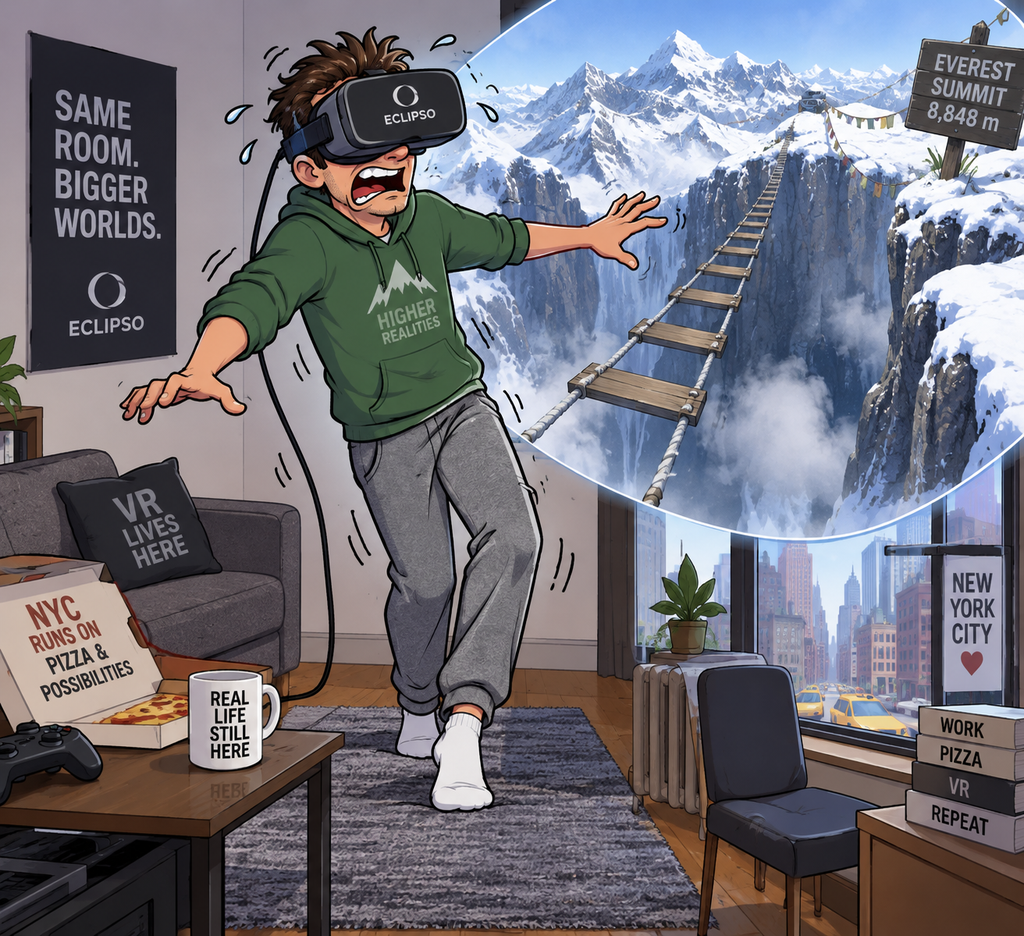
The reason you experience terrifying vertigo inside a flat, safe room comes down to a fundamental glitch in how the human brain processes reality: your visual system almost always overrides your cognitive knowledge.
Even though your conscious brain knows you paid for a ticket and are standing on a flat carpet in Manhattan, your primal subconscious brain relies on a complex, multi-sensory balancing act that virtual reality easily hijacks.
The Optical Takeover (Vection)
Your brain determines its position in space largely through the ambient motion in your peripheral vision. When you put on an enterprise VR headset with a wide, 120-degree field of view, the simulation completely replaces your visual horizon.
- The Glitch: When you look down at a virtual 2,000-foot drop in the Khumbu Icefall, your eyes send a massive, high-priority panic signal to your brain saying, “We are falling/elevated!”
- The Override: Because the visual data is so overwhelming and high-resolution, your brain instantly suppresses the quieter, cognitive memory that you are actually in a building.
The Sensory Mismatch (Vestibular Conflict)
Your sense of balance is controlled by the vestibular system (the fluid-filled canals in your inner ear) working in perfect harmony with your eyes. Vertigo occurs when these two systems violently disagree.
- In the Real World: If you look off a high cliff, your eyes see immense depth while your inner ears and feet feel stationary, triggering a mild, thrilling sense of height.
- In the VR Environment: Your eyes see a terrifying, bottomless crevasse dropping away beneath a narrow ladder, but your feet feel the solid, flat floor. This massive sensory contradiction causes the brain to panic. It interprets the conflicting signals as disorientation, instantly triggering a physical survival response: a racing pulse, sweaty palms, and a surge of adrenaline.
Proprioceptive “Gaslighting”
Proprioception is your body’s ability to sense its own movement and micro-balance adjustments.
- Because Eclipso uses a free-roam tracking grid, you are physically walking with your real legs.
- When your brain detects that your muscles are moving to take a step, and the virtual world responds with millimeter precision, the brain completely surrenders its skepticism. It concludes that the virtual environment must be real physical space.
By tricking your eyes, ears, and feet into a three-way argument, the software bypasses your logical intellect entirely, forcing your body to react to the virtual cliff exactly as it would to a real one.
The Funny and Chaotic Encounters of People on Different Adventures Encountering Each Other in the Same Room
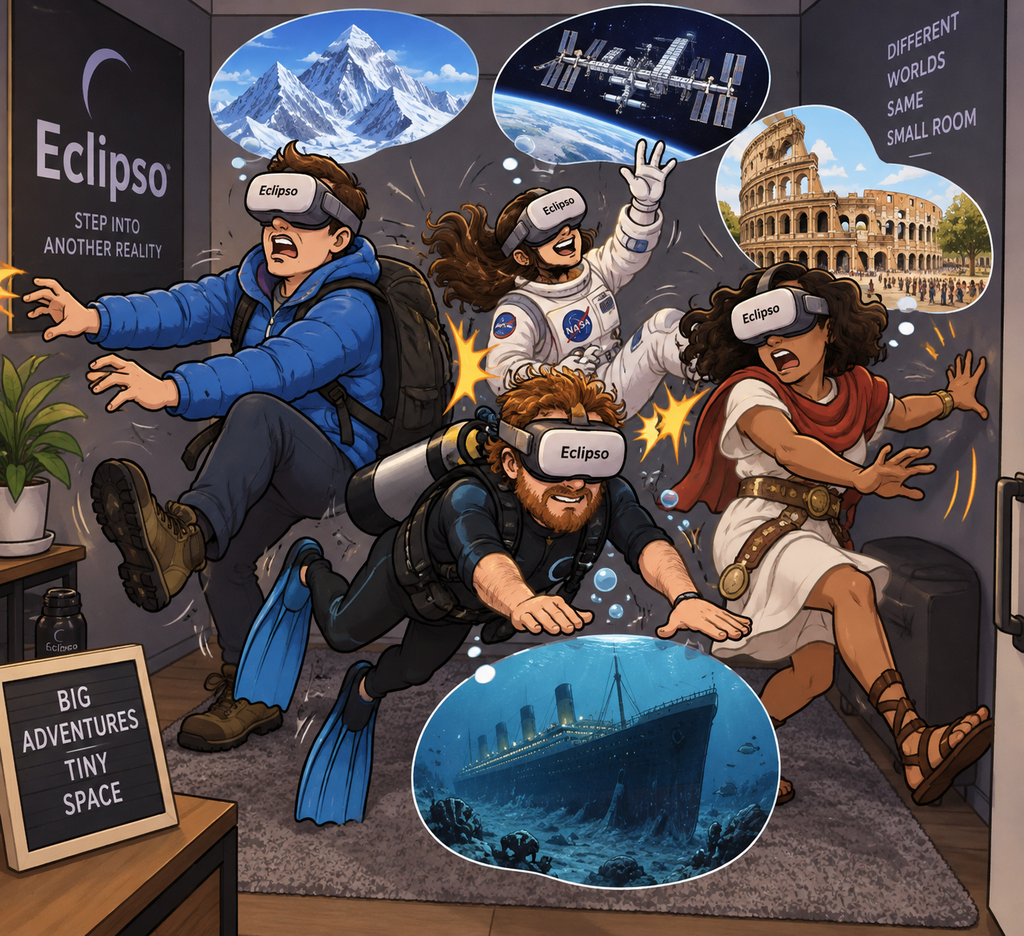
People Going On Other Adventures in the Same Small Room
In addition to Everest, Eclipso has the following adventures happening in the same room, within a few feet of you. You are encouraged not to talk to each other during the adventure, but this is widely ignored, leading to bizarre interactions.
- Space Explorers: THE INFINITE – A 360-degree journey aboard the International Space Station featuring real NASA footage and astronaut interviews. (Closing November 8, 2026) [1, 2, 3]
- Titanic: Echoes from the Past – Step back to 1912 to walk the decks of the ship and dive into its modern deep-sea wreckage. (Open through November 29, 2026) [1, 2]
- Everest: The First Ascent – Climb the Himalayas alongside the historic 1953 expedition led by Tenzing Norgay. (Open through February 2027) [1, 2]
- Colosseum: The Arena of Legend – Explore 1st-century Imperial Rome and the gladiator life. [1]
Putting multiple people in a shared physical space while they are completely blind to each other in separate, massive virtual worlds creates a hilarious, chaotic comedy of errors.
Because Eclipso uses “free-roam” tracking, people are physically walking around the room. Even though the venue’s tracking software keeps people from literally sprinting into walls, the sensory disconnect leads to some incredibly funny, strange, and awkward interactions:
The “Ghost Collision” Panics
When you are on your own journey, you might be walking through a narrow ice crevice on Mount Everest, while the person next to you is exploring a grand ballroom on the Titanic.
- The Interaction: Suddenly, a proximity warning or a vague virtual boundary pops up in your headset because you’re getting close to another human. To you, an invisible “ghost” is invading your solitary mountain peak. People frequently freeze, freak out, or start aggressively apologizing to empty air.
Cross-Talk Conversations
Unless you are using noise-canceling headphones, you can hear the physical room around you.
- The Interaction: You’re trying to have a solemn, awe-inspiring moment looking at the Earth from the International Space Station, but three feet away, someone on the Titanic journey is screaming, “Oh my god, the water is coming up, Harold, where are you?!” It creates a bizarre, overlapping soundscape of completely unrelated emotional breakdowns.
Bizarre Physical Postures
Each VR journey demands different physical reactions, which look entirely unhinged to anyone else in the room (or to staff watching).
- The Interaction: Someone on the Colosseum tour might be ducking and dodging a virtual gladiator sword, while someone next to them trying to “climb” a ladder on THE INFINITE is reaching high into the air and groping the ceiling. If they accidentally brush hands, both people usually jump out of their skin.
The Accidental “Wind” Effects
People move their arms a lot in VR.
- The Interaction: You might be quietly standing still, admiring a Roman statue, when suddenly you feel a sudden, aggressive gust of wind pass your face. You didn’t realize that the guy next to you just tried to throw a virtual flare on Mount Everest, narrowly missing your actual nose with his controller.
The “Zombies in Slow Motion” Room
If you take your headset off for a second, looking at the room as a regular human is the funniest part of all. You just see a dozen adults wearing heavy plastic goggles, wandering around a blank room in slow, tentative steps, talking to walls, and occasionally high-fiving the air.
- Humorous Overview of Eclipso’s VR Everest Experience
- Key Details and History
- How Eclipso Created the Experience
- The Journey: Stages of the Climb
- Technical Aspects
- Location-Based Entertainment (LBE)
- Reviews
- How the VR Story Condenses the Climb
- Creating Vertigo in a Small Flat Space
- The Funny and Chaotic Encounters of People on Different Adventures Encountering Each Other in the Same Room