Jokes
- Why do mountain climbers make terrible romantic partners? Because the moment they hit a rough patch, they blame the “third man factor” for why there are three people in the relationship.
- A climber starts stripping off his gear at 28,000 feet. His partner screams, “What are you doing?! It’s minus forty degrees!” The climber replies, “Relax, it’s just paradoxical undressing. I wanted to look hot for the summit photo.”
- Why did the mountaineer break up with his girlfriend at exactly 2:01 PM? She wanted to keep talking, but he strictly enforces the turn-back rule.
- Two hallucinations are walking down the Death Zone. One turns to the other and says, “Do you ever get the creepy feeling we’re being followed by a real mountain climber?”
- How do you know you’ve been in the death zone too long? When you start asking “Green Boots” for driving directions.
The Mind and Body at Extremes
Mountain climbers and high-altitude alpinists regularly encounter strange physiological, psychological, and behavioral oddities driven by extreme environments.
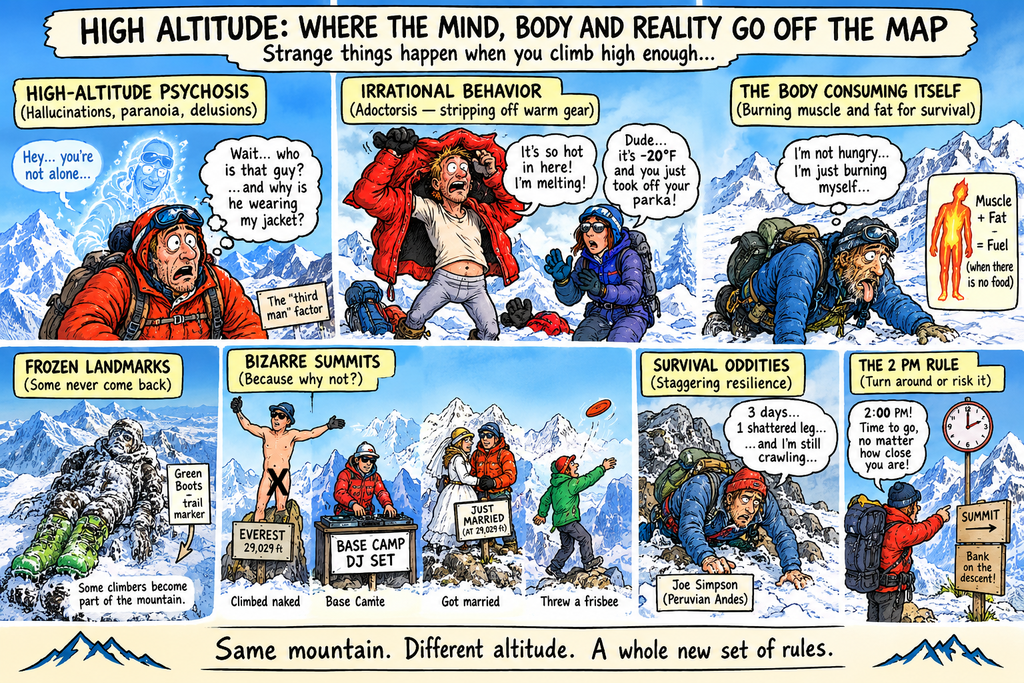
- High-Altitude Psychosis: Thin air and severe oxygen starvation (hypoxia) in the “death zone” (above 8,000 meters) can trigger hallucinations, paranoia, and delusions. Climbers have reported hearing voices, seeing phantom people, or feeling like someone else is walking beside them (known as the “third man factor”). [1, 2, 3, 4]
- Irrational Behavior: Hypoxia can cause climbers to lose the ability to think clearly. In extreme states of confusion, climbers have experienced “adoctorsis” or paradoxical undressing—stripping off heavy, life-saving parkas and gloves in sub-zero weather because they suddenly feel intensely hot. [1, 2]
- The Body Consuming Itself: When pushing past the limits of human physiology at high altitudes, the body stops processing food normally and begins burning its own muscle tissue and fat stores just to stay warm and move. [1]
Macabre Milestones
- Frozen Landmarks: On routes like Mount Everest, deceased climbers whose bodies cannot be retrieved due to extreme cold and logistics have sometimes remained frozen in place for decades. Expeditions have historically used distinct items of clothing—such as a pair of bright “Green Boots”—as literal trail markers. [1, 2, 3]
- Bizarre Summits: Mountaineers have set unusual, unorthodox records at the highest points on Earth. These include individuals climbing naked, playing DJ sets at base camp, getting married at the summit, or throwing a frisbee in the thin air. [1]
Survival Oddities
- Extreme Crawling and Resilience: Alpinists have survived staggering trauma against all medical odds. Examples include Joe Simpson crawling for three days down the Peruvian Andes with a shattered leg after his partner accidentally cut his rope, or climbers enduring days trapped on vertical ice ledges with no food or water. [1, 2]
- The 2 PM Rule: To stay alive, guides enforce a strict psychological and physical boundary known as the 2 PM rule. If a climber does not reach the summit by 2:00 PM local time, they are forced to turn around immediately—even if the peak is only minutes away—to ensure they can descend before darkness and freezing temperatures set in. [1]