
People who make a dedicated habit of seeking out the highest point in every place they visit (sometimes called “highpointers” in geographer or traveler subcultures) display specific psychological traits across major personality frameworks such as the Big Five and the Myers-Briggs Type Indicator (MBTI).
Jokes About Highpointer Personality Traits
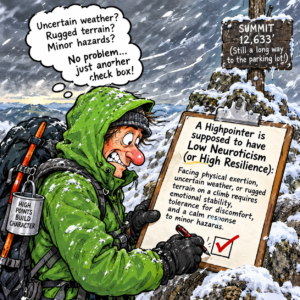
- Highpointers don’t have low neuroticism—they just consider “unexpected hail” a scenic feature.
- Their stress response is so calm, it waits until they’re safely back at the car.
- A rugged trail, uncertain weather, and a questionable bridge? “Sounds manageable.” The parking fee, though—that’s concerning.
- High resilience is reaching the summit after three false peaks and still saying, “At least the next one looks closer.”
- Their idea of a minor hazard is a loose rock. Their idea of a crisis is realizing the summit register is out of ink.
- Highpointers don’t panic when the trail disappears. They calmly start calling it “route-finding.”
- “How was the climb?” “Fine. The mountain got a little emotional about the weather.”
- They’re not fearless; they’ve just learned that worrying uses energy better spent on the uphill.
Background on Highpointer Personality Traits from AI
Big Five Personality Traits
- High Openness to Experience: This is the strongest driver. High openness correlates with curiosity, a love of novelty, and a desire for aesthetic or awe-inspiring experiences. Reaching a summit offers a panoramic perspective and a sense of discovery. [1]
- High Conscientiousness: Highpointers are often goal-driven, systematic, and obsessive about completionist lists. Checking off a high point requires research, route planning, physical endurance, and a structured sense of accomplishment.
- Low Neuroticism (or High Resilience): Facing physical exertion, uncertain weather, or rugged terrain on a climb requires emotional stability, tolerance for discomfort, and a calm response to minor hazards.
- The Analyst / Thinker Types (e.g., INTJ, ENTJ, INTP): These types love systems, challenges, and mastery. Treating geography as a puzzle or a completionist quest strongly appeals to their internal logic and independence. [1]
- The Explorer / Adventurer Types (e.g., ISTP, ESTP): Driven by physical interaction with the environment, tangible risk, and active thrills rather than passive sightseeing. [1]
- The “Thrillseeker” or “Mastermind” Travel Personas: In modern travel psychology studies, these individuals align closely with Thrillseekers (who seek active exploration and local challenges) and Masterminds (who relish logistics, tracking, and ticking off specific targets on a checklist). [1]