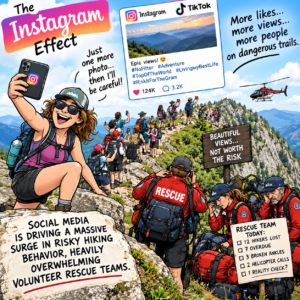
Recent reports from search-and-rescue organizations worldwide confirm that the “Instagram effect” on TikTok and Instagram is driving a massive surge in risky hiking behavior, overwhelming volunteer rescue teams.
Jokes About Instagram Hiking
- Instagram: “A gentle stroll with breathtaking views.” Reality: three hours uphill, one granola bar, and a rescue helicopter adding the best aerial shot of the day.
- TikTok said, “You can do this hike in sneakers.” The mountain said, “Great—now you can do the rescue in sneakers too.”
- They packed for the algorithm: phone, ring light, and a cute jacket. The mountain requested: water, layers, a map—and maybe fewer outfit changes.
- “The trail looked easy online!” Sure—it was posted by someone who edited out the climb, the weather, and the part where the rescue team got involved.
- The only thing more scenic than the summit? The rescue crew carrying someone’s “casual day hike” back down.
- Influencers say, “Just follow the trail!” Rescue teams say, “Please don’t follow a stranger’s three-second video into the wilderness.”
- “The hike is only 20 minutes,” the video said. It forgot to mention that was 20 minutes of edited footage spread across six hours.
- They brought a phone for navigation, but the trail had no signal. Luckily, the rescue team brought an old-fashioned map—and actual pants.
- “Pack light,” said the influencer. So they left the water, snacks, and jacket at home. The mountain packed on the consequences.
- The post said “easy access to the summit.” It didn’t say whether that meant walking, climbing, or being carefully escorted by mountain rescue.
- They went looking for a photo spot and found a spot where the rescue team could get a clear view of them.
- Their hiking checklist: phone charged, playlist ready, caption drafted. The rescue team’s checklist: water, first aid, warm layers, and “please stop treating TikTok as a topographic map.”
- “It’s just a short trail,” they said. The mountain replied with a long lesson in elevation gain.
- The best filter for a mountain hike? Good judgment. It makes the views better and the rescue call less likely.
Background on Phenomenon
Following is compiled from AI reports.
Data shows a stark demographic shift: young adults (ages 18–24), who historically were among the least likely to need rescue, have now become the leading demographic for emergency mountain callouts in regions like the UK and North America. In places like the Scottish Highlands, rescues for this age bracket have nearly quadrupled, while Mountain Rescue England and Wales reported that emergencies involving young adults have roughly doubled. [1, 2, 3, 4]
The crisis stems from several overlapping trends driving people into perilous terrain unprepared:1. The “Inspiration vs. Preparation” GapSocial media algorithms heavily favor highly aesthetic, effortless-looking media—such as a creator looking flawless at a dramatic, foggy summit or on a sheer cliff edge. Experts note that these short clips edit out the grueling reality of the trek. Viewers rarely see the hours of planning, the heavy safety gear, the extreme weather shifts, or the physical exhaustion required to get there. [1]2. Extreme Under-PreparationSeduced by a 15-second viral video, many casual hikers hit complex, high-altitude trails completely unequipped. Rescue teams frequently report extracting young hikers from freezing, sub-zero mountain environments who are wearing nothing but tracksuits, t-shirts, and casual sneakers—completely lacking insulated jackets, headlamps, water, or proper navigation tools. [1, 2, 3]3. Over-Reliance on Inadequate Digital ToolsRather than using dedicated, offline topographic trail maps, a rising number of social media-driven hikers rely entirely on standard urban navigation tools like Google Maps or basic smartphone apps to guide them up mountains. These apps lack the necessary terrain, elevation, and safety data, frequently miscalculating trail durations or leading hikers directly off-trail into dangerous drop-offs and cliffs. [1, 2, 3]Global CountermeasuresThe issue has forced global authorities and organizations to take active measures:
- Enforced Regulations: In countries like Malaysia, officials have cracked down on social media hiking trends by making mountain guides mandatory at nearly 200 high-risk locations. [1]
- The “No Geotag” Movement: A cultural push has emerged within the outdoor community urging hikers and influencers to stop using precise location tags. Instead, they are encouraged to use broad tags (e.g., tagging a whole state rather than a specific fragile trailhead) to prevent viral overcrowding. [1, 2, 3]