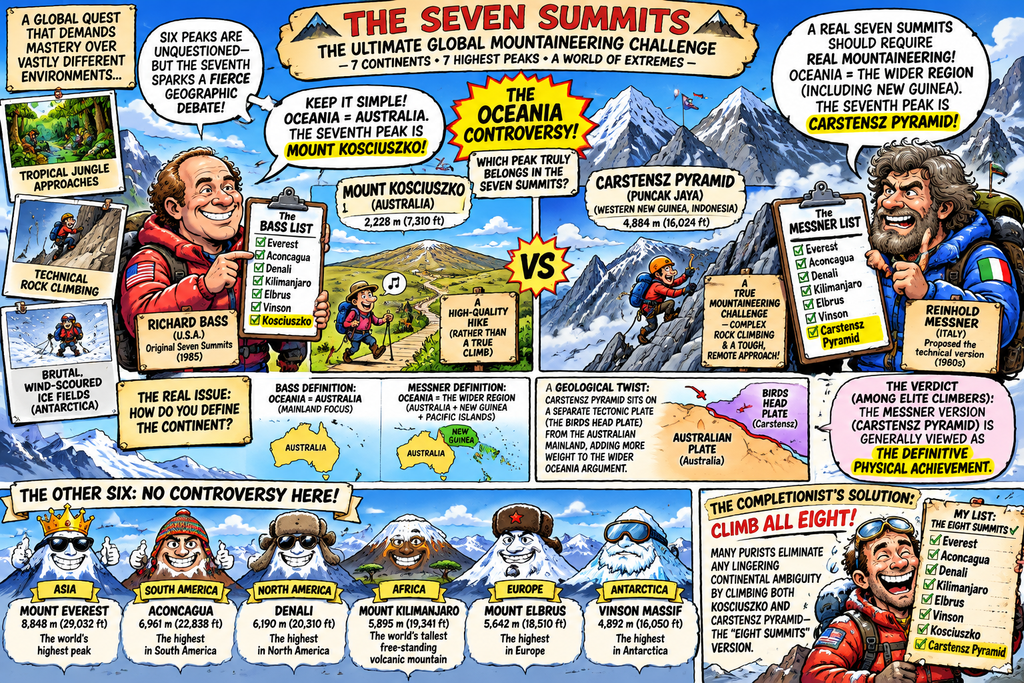
Here’s a list of the highest points in countries on all 7 continents. It’s straightforward on six continents, but complicated on Australia/Oceania; there’s a debate about whether Indonesia, which is considered part of Asia, should be on the Oceania list
Should 7 Summits Really Be 8?
The Seven Summits represent the ultimate crown jewel of high-altitude mountaineering, demanding mastery over vastly different environments ranging from the technical rock and jungle approaches of the tropics to the brutal, wind-scoured ice fields of Antarctica. While icons like Asia’s Mount Everest (the world’s highest peak) and Africa’s Mount Kilimanjaro (the planet’s tallest free-standing volcanic mountain) are universally accepted, the circuit features a fierce geographic debate regarding its final peak. The defining controversy centers on Oceania, specifically the contrast between the “Bass List” and the “Messner List” over which summit truly belongs.
The dilemma hinges entirely on how one defines the continental boundaries of Australia and Oceania. The original list, compiled by American businessman Richard Bass in 1985, includes mainland Australia’s Mount Kosciuszko; however, at just 2,228 meters, it is essentially a highly accessible hike rather than a true mountaineering challenge. Seeking a version that required actual technical climbing skills, famed mountaineer Reinhold Messner proposed expanding the definition to the wider region of Oceania, thereby cementing the far more formidable Carstensz Pyramid (Puncak Jaya) in Western New Guinea, Indonesia (4,884 meters), as the rightful seventh peak. Because Carstensz Pyramid requires advanced rock climbing and sits on a separate tectonic plate from the Australian mainland, most elite mountaineers regard the Messner version as the definitive physical achievement, though many purists choose to climb all eight variations to eliminate any lingering continental ambiguity.
Humorous Overview of Oceania Debate
- Why do mountaineers climb both Mount Kosciuszko and Carstensz Pyramid? Because they don’t want their multi-million-dollar climbing legacy ruined by a geographer who can’t decide where Australia ends.
- Choosing the Bass List over the Messner List is the mountaineering equivalent of counting the stairs to your apartment as a high-altitude workout.
- Climbers on Mount Kosciuszko have to stay hyper-vigilant. If they aren’t careful, they might get run over by a toddler on a balance bike or overtaken by a grandmother power-walking with a latte.
- Reaching the summit of Carstensz Pyramid requires technical rock climbing, jungle navigation, and political permits. Reaching the summit of Mount Kosciuszko requires an extra bottle of sunscreen and a willingness to wait in line behind a school field trip.
- The tectonic plates in Oceania move about as fast as geographers trying to agree on what a continent is, leaving climbers stuck paying for two completely different plane tickets just to cover their bases.
- You know you’re on the wrong Seven Summits list when your “extreme high-altitude expedition” ends with a celebratory lunch at a ski resort cafe with a fully functioning espresso machine.
- Geographers argue about tectonic plates and continental shelves, while mountaineering companies just smile and cash the checks for peak number eight.