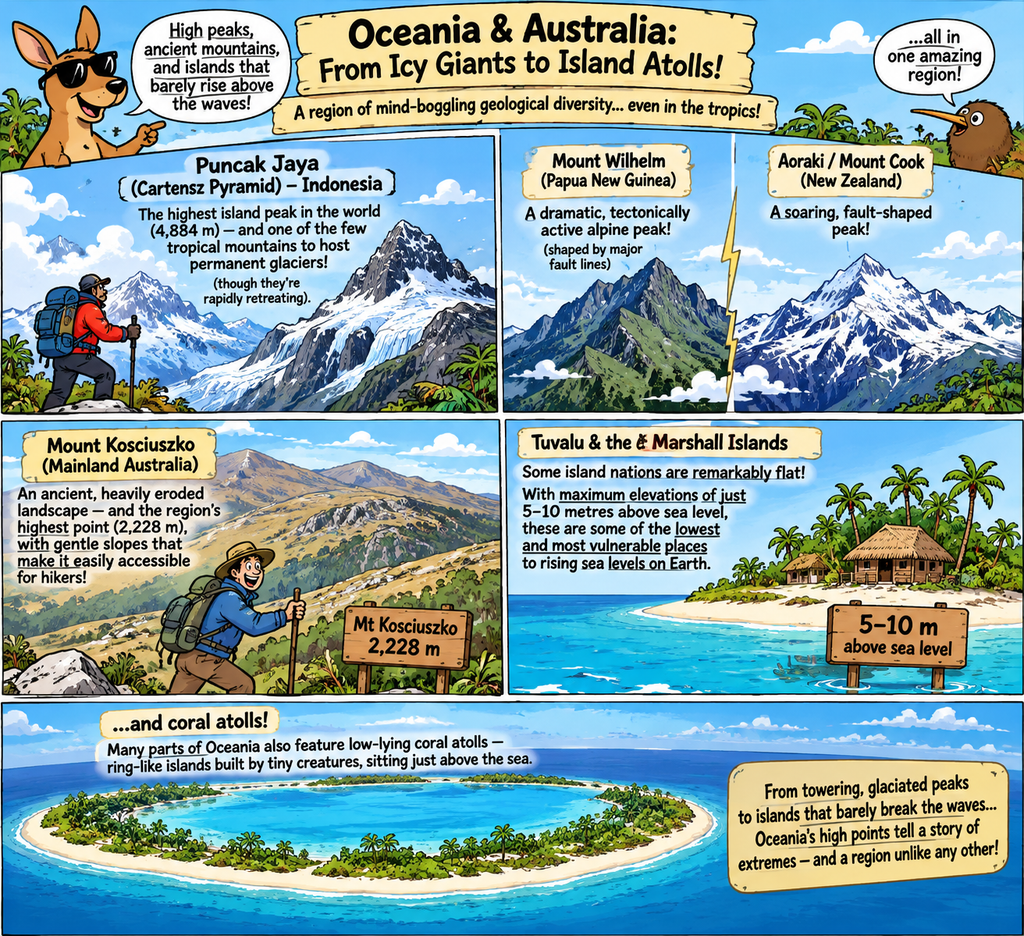
The high points of Oceania and Australia are defined by extreme geological diversity, ranging from glaciated equatorial peaks to low-lying coral atolls. Despite being in a tropical zone, Puncak Jaya (Carstensz Pyramid) in Western New Guinea is the highest island peak in the world and one of the few tropical mountains to host permanent glaciers, though they are rapidly retreating.
The region features a sharp contrast between the dramatic, tectonically active alpine terrains of Papua New Guinea’s Mount Wilhelm and New Zealand’s Aoraki / Mount Cook—both shaped by major fault lines—and the ancient, heavily eroded landscape of mainland Australia’s Mount Kosciuszko, which is easily accessible to hikers due to its gentle slopes. Conversely, many of the region’s small island nations are remarkably flat; countries like Tuvalu and the Marshall Islands have maximum elevations of just 5 to 10 meters above sea level, making their high points some of the lowest and most vulnerable to rising sea levels on Earth.
The highest point in the entire region of Oceania and Australia is Puncak Jaya (Carstensz Pyramid) in Indonesia at 4,884 meters (16,024 feet).
Depending on whether you look at the region by sovereign country or continental definition, the highest points for major nations across Oceania and Australia include:
Highest Points by Country (Sovereign States)
- Indonesia (Western New Guinea): Puncak Jaya (Carstensz Pyramid) – 4,884 m (16,024 ft)
- Papua New Guinea: Mount Wilhelm – 4,509 m (14,793 ft)
- New Zealand: Aoraki / Mount Cook – 3,724 m (12,218 ft)
- Solomon Islands: Mount Popomanaseu – 2,335 m (7,661 ft)
- Australia (Mainland): Mount Kosciuszko – 2,228 m (7,310 ft) (Note: Australia’s overall highest territory point, including sub-Antarctic islands, is Mawson Peak on Heard Island at 2,745 m)
- Vanuatu: Mount Tabwemasana – 1,877 m (6,158 ft)
- Samoa: Silisili (Mauga Silisili) – 1,857 m (6,093 ft)
- Fiji: Mount Tomanivi – 1,324 m (4,344 ft)
- Tonga: Kao – 1,033 m (3,389 ft)
- Federated States of Micronesia: Nanlaud (Patrocinio) – 782 m (2,566 ft)
- Palau: Mount Ngerchelchuus – 242 m (794 ft)
- Kiribati: Banaba (High Point) – 81 m (266 ft)
- Nauru: Command Ridge – 71 m (233 ft)
- Marshall Islands: Likiep (Unnamed high point) – 10 m (33 ft)
- Tuvalu: Niulakita – 5 m (16 ft) [1, 2, 3, 4]
The Seven Summits / Regional Debate
The highest point of Oceania varies depending on how the continent or region is bounded:
- The Messner List uses Puncak Jaya (4,884 m) in Indonesia.
- The Bass List uses Mount Kosciuszko (2,228 m) on the Australian mainland.
- Mount Wilhelm (4,509 m) serves as the highest peak in the independent nation of Papua New Guinea.
Humorous Overview
- Tuvalu’s high point is five meters above sea level, which means you can conquer the nation’s highest peak simply by putting on a pair of platform shoes.
- Climbers on the Bass list love to brag about conquering Australia’s highest peak, but “summiting” Mount Kosciuszko is less a mountaineering triumph and more an aggressive uphill power walk to a gift shop.
- Puncak Jaya features tropical glaciers that are melting so fast due to climate change that mountaineers aren’t sure whether to pack an ice axe or a pair of Speedos.
- The Marshall Islands’ highest point is ten meters, meaning the biggest elevation change most locals experience is walking up the stairs to the second floor of a beach resort.
- Australia’s highest peak is actually Mawson Peak on a freezing, remote sub-Antarctic island, but mainlanders decided it was much easier to just point at a gentle hill in New South Wales and call it a day.
- The debate between Puncak Jaya and Mount Kosciuszko for the Seven Summits is intense, largely because mountaineers want to know whether they need to train for months in extreme alpine conditions or can just wear flip-flops.
- New Zealand’s Aoraki/Mount Cook lost 10 meters of height in a massive rockfall, proving that even the geography of Oceania is trying to find a quicker way down to the beach.