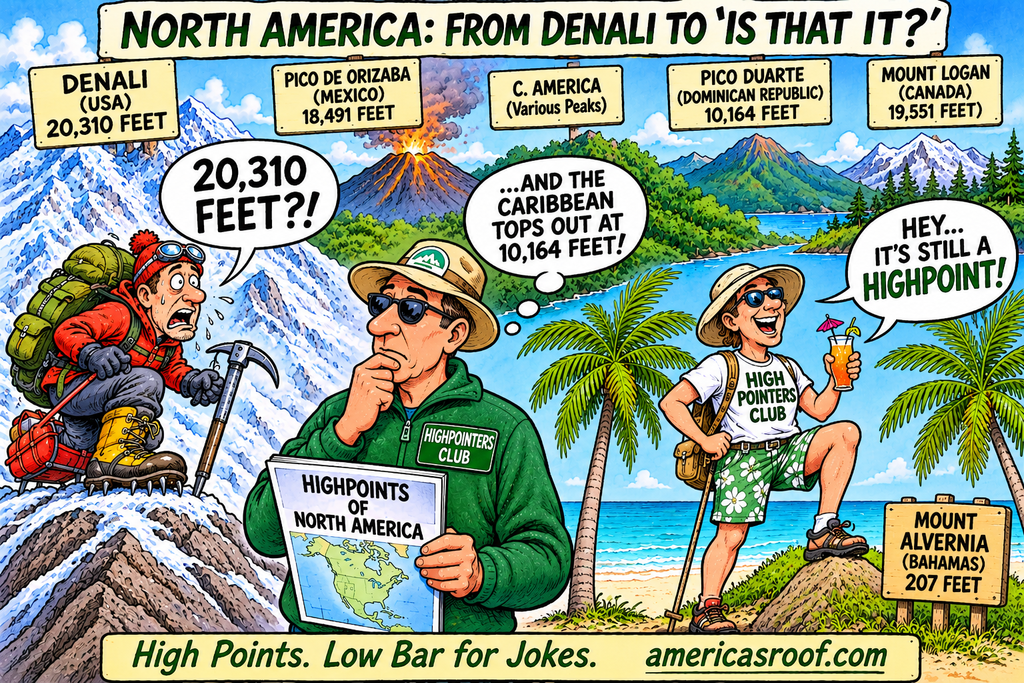
The highest natural elevations of sovereign states in North America range from Denali in the United States down to Mount Alvernia in the Bahamas, as compiled in the List of highest points of North American countries
- United States: Denali – 6,190 m (20,310 ft)
- Canada: Mount Logan – 5,959 m (19,551 ft)
- México: Pico de Orizaba – 5,636 m (18,491 ft)
Central America
Volcán Tajumulco is the highest peak in Central America, located in Guatemala.
The high points for all seven Central American nations are:
- Guatemala: Volcán Tajumulco – 4,220 m (13,845 ft)
- Costa Rica: Cerro Chirripó – 3,819 m (12,530 ft)
- Panamá: Volcán Barú – 3,475 m (11,401 ft)
- Honduras: Cerro Las Minas – 2,870 m (9,416 ft)
- El Salvador: Cerro El Pital – 2,730 m (8,957 ft)
- Nicaragua: Mogotón – 2,107 m (6,913 ft)
- Belize: Doyle’s Delight – 1,124 m (3,688 ft)
Caribbean
Pico Duarte is the highest peak in the Caribbean, located in the Dominican Republic. [1]
The high points for the sovereign island nations of the Caribbean are:
- Dominican Republic: Pico Duarte – 3,098 m (10,164 ft)
- Haiti: Pic la Selle – 2,674 m (8,773 ft)
- Jamaica: Blue Mountain Peak – 2,256 m (7,402 ft)
- Cuba: Pico Turquino – 1,974 m (6,476 ft)
- Dominica: Morne Diablotins – 1,447 m (4,747 ft)
- Saint Vincent and the Grenadines: La Soufrière – 1,234 m (4,049 ft)
- Saint Kitts and Nevis: Mount Liamuiga – 1,156 m (3,793 ft)
- Saint Lucia: Mount Gimie – 950 m (3,125 ft)
- Trinidad and Tobago: El Cerro del Aripo – 940 m (3,087 ft)
- Grenada: Mount Saint Catherine – 840 m (2,756 ft)
- Antigua and Barbuda: Mount Obama – 402 m (1,319 ft)
- Barbados: Mount Hillaby – 340 m (1,115 ft)
- Bahamas: Mount Alvernia – 63 m (207 ft) [1, 2, 3, 4]
Highpoints ofTerritories, Collectivities, and Dependencies in North America and the Caribbean.
La Grande Soufrière is the highest point among the various territories, collectivities, and dependencies in North America and the Caribbean. [1]
The high points for the major territories and overseas dependencies in this region are:
- Guadeloupe (France): La Grande Soufrière – 1,467 m (4,813 ft)
- Martinique (France): Montagne Pelée – 1,397 m (4,583 ft)
- Puerto Rico (United States): Cerro de Punta – 1,338 m (4,390 ft)
- Montserrat (United Kingdom): Soufrière Hills Volcano – 914 m (2,999 ft)
- Saba (Netherlands): Mount Scenery – 870 m (2,854 ft)
- British Virgin Islands (United Kingdom): Mount Sage – 521 m (1,710 ft)
- U.S. Virgin Islands (United States): Crown Mountain – 474 m (1,555 ft)
- Saint Martin (France): Pic Paradis – 424 m (1,391 ft)
- Sint Maarten (Netherlands): Flagstaff (border ridge) – 383 m (1,257 ft)
- Saint Barthélemy (France): Morne du Vitet – 286 m (938 ft)
- Bonaire (Netherlands): Brandaris – 241 m (791 ft)
- Saint-Pierre-et-Miquelon (France): Morne de la Grande Montagne – 240 m (787 ft)
- Aruba (Netherlands): Jamanota – 188 m (617 ft)
- Curaçao (Netherlands): Christoffelberg – 375 m (1,230 ft)
- Cayman Islands (United Kingdom): The Bluff – 43 m (141 ft) [1, 2, 3, 4, 5]
(Note: Greenland is technically an autonomous territory of Denmark, but due to its scale and continental classification, its high point—Gunnbjørn Fjeld at 3,694 m—is typically listed alongside sovereign mainland nations). [1]
Humorous Overview
- United States (Denali): Denali is so massive and remote that mountaineers spend weeks hauling heavy sleds through sub-zero blizzards, risking frostbite, crevasses, and avalanches—all just to stand on a summit where the view looks exactly like the inside of a freezer bag.
- Canada (Mount Logan): Logan is the widest mountain mass on Earth, meaning it has a massive summit plateau. If you finally survive the grueling, freezing ascent to the top, your reward is a flat, featureless ice field so vast you’ll forget you’re on a mountain and feel like you’re just wandering around a really cold Costco parking lot.
- Mexico (Pico de Orizaba): Orizaba is an active volcano, meaning climbers have to dodge loose volcanic scree, navigate a steep glacier, and breathe through sulfur vents. It’s the perfect place to combine the exhausting aerobic misery of high-altitude mountaineering with the sensory experience of standing right behind a city transit bus.
- Guatemala (Volcán Tajumulco): Tajumulco is the highest peak in Central America, but because it’s a relatively straightforward hike, the biggest hazard isn’t the altitude—it’s the local dogs that follow you from the trailhead, easily summiting beside you without boots or a jacket, completely shattering your ego.
- Costa Rica (Cerro Chirripó): To climb Chirripó, you have to book a permit months in advance, hike through a dense cloud forest, and freeze in a high-altitude paramo. It’s the only place in Costa Rica where you can pay a premium to actively avoid the beach, catch hypothermia, and get out-paced by a pack mule hauling someone else’s clean laundry.
- Dominican Republic (Pico Duarte): Pico Duarte features a bronze bust of Juan Pablo Duarte at the summit. After hiking 14 grueling miles through the mountains, nothing says “congratulations” quite like staring into the cold, unblinking metal eyes of a 19th-century founding father who looks like he’s judging your choice of footwear.
- The Bahamas (Mount Alvernia): At 63 meters (207 feet), you don’t climb Mount Alvernia; you accidentally visit it while looking for a dropped flip-flop. The hardest part of the expedition is resisting the urge to call it a “steep driveway.”
- Panama (Volcán Barú): Barú is famous because on a clear day, you can see both the Atlantic and Pacific Oceans from the summit. Of course, the summit is almost always completely socked in by thick fog, meaning you hike through the dark for six hours just to stand next to a cluster of rusty radio towers and look at a wall of white mist that looks exactly like a damp bedsheet.
- El Salvador (Cerro El Pital): The highpoint of El Salvador is a heavily forested hill right on the border with Honduras. It features a border monument and a popular campsite, meaning you can fight your way through the heat, reach the absolute pinnacle of the nation, and find yourself standing next to a family having a barbecue while playing reggaeton out of a portable speaker.
- Belize (Doyle’s Delight): This peak is so deeply buried in a remote, pristine rainforest that the only way to reach it without a machete and a week of misery is by helicopter. It is the ultimate highpointing paradox: a mountain peak where the primary climbing skill required is having a rich uncle with a pilot’s license.
- Haiti (Pic la Selle): The road to Pic la Selle is so rough and broken that your vehicle will suffer far more altitude sickness than you will. By the time you reach the pine forests near the top, your spine has been compressed so much by the potholes that you are technically two inches shorter than when you started the climb.
- Nicaragua (Mogotón): Located right on the Honduran border, this highpoint was surrounded by active landmines left over from the 1980s conflicts until a massive clearing operation took place. It’s the only peak where the traditional mountaineering advice “watch your step” isn’t about twisting an ankle, but about accidentally altering the local geography.
- Jamaica (Blue Mountain Peak): Most people start this hike at 2:00 AM to catch the sunrise. This ensures that you experience the lush, world-famous coffee plantations and tropical biodiversity of Jamaica as a pitch-black abyss where you occasionally trip over a tree root and curse in the dark.
- Honduras (Cerro Las Minas): Also known as Pico Celaque, this mountain is surrounded by a cloud forest so dense it shuts out the sky. You spend hours ascending steep, muddy slopes under a dripping canopy, entirely convinced you are scaling a legendary peak, only to realize the summit is just a flat patch of dirt surrounded by bushes that blocks any hope of a view.
- Guadeloupe (La Grande Soufrière): Why did the climber refuse to pay the guide on France’s highest territory peak? Because the service was absolute garbage and the tip was just a bunch of hot air.
- Montserrat (Soufrière Hills): Trying to bag the highpoint of Montserrat is the ultimate administrative nightmare. You don’t just need a climbing permit; you need a permission slip from a vulcanologist, a hard hat, and a written apology to the tectonic plates.
- Puerto Rico (Cerro de Punta): Climbers love bragging about scaling Cerro de Punta until they realize you can literally drive a sedan to the top. Nothing ruins your hardcore mountaineering aesthetic quite like getting summited by a 2012 Toyota Corolla.
- Saba (Mount Scenery): Hiking up Mount Scenery is just a 1,064-step staircase built into a rainforest. It’s not mountaineering; it’s just nature’s version of a gym StairMaster where the humidity is set to “steaming sauna.”
- Cayman Islands (The Bluff): At a whopping 43 meters, you don’t need oxygen or crampons to summit the Cayman Islands. If you trip over a stray coconut at the beach, you’ve basically descended halfway down the mountain.
- The Bahamas (Mount Alvernia): It takes a lot of nerve to call a 63-meter bump a “mount.” It’s the only national highpoint where the biggest risk of altitude sickness comes from standing on a particularly thick beach towel.