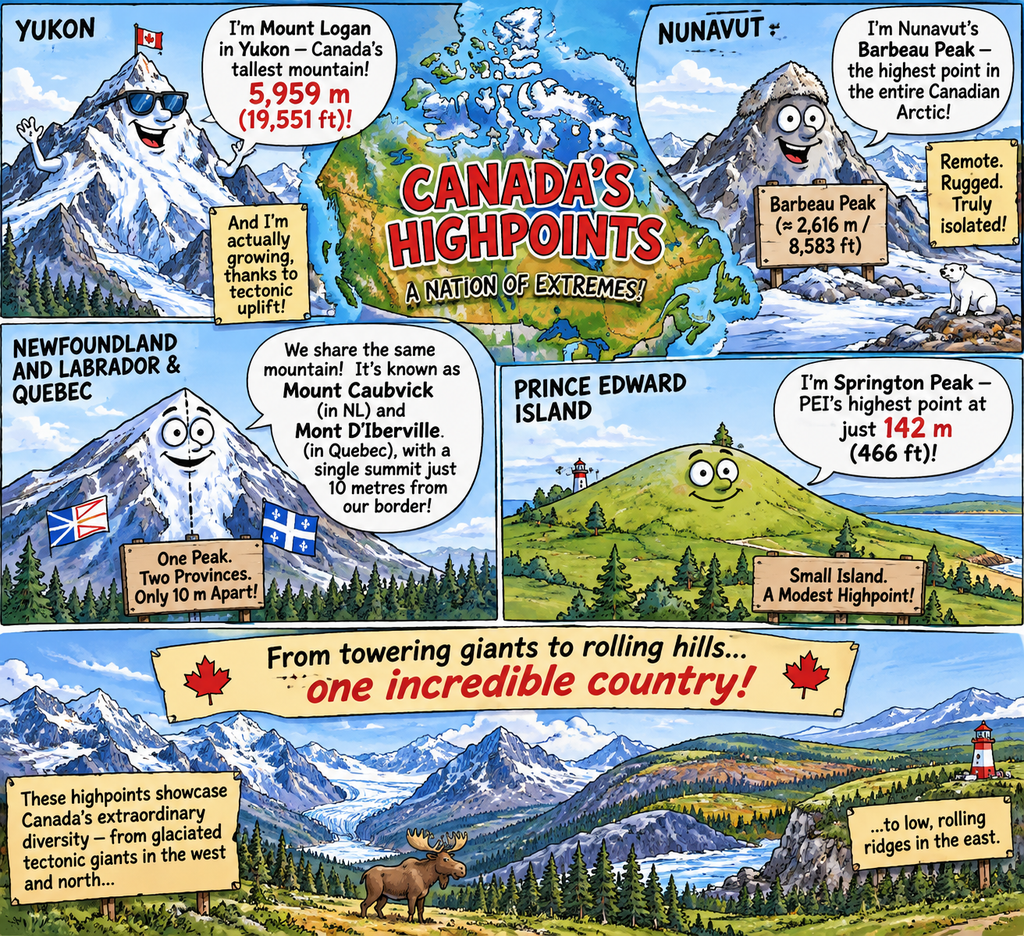
Canadian provincial and territorial highpoints exhibit extreme geographic and elevation diversity, spanning from towering, glaciated tectonic giants in the west and north to low, rolling hills and ridges in the east. The pinnacle of these landmarks is Mount Logan in the Yukon, Canada’s tallest mountain at 5,959 meters (19,551 feet), which is actively rising due to ongoing tectonic uplift.
In stark contrast, the country’s lowest regional highpoint is in Prince Edward Island, where Springton Peak reaches a modest elevation of 142 meters (466 feet). The highpoints also feature unique geographical anomalies; for instance, Newfoundland and Labrador and Quebec share the same mountain massif—known respectively as Mount Caubvick and Mont D’Iberville—with a single summit just 10 meters from the provincial border.
Additionally, remote peaks like Nunavut’s Barbeau Peak highlight the ultimate isolation of Canada’s geography, anchoring the British Empire Range as the highest point in the entire Canadian Arctic. [1, 2, 3, 4, 5]
The highest points of each of Canada’s 10 provinces and 3 territories (with Quebec and Newfoundland & Labrador sharing a border peak) are listed below from highest to lowest: [1, 2]
| Rank | Province or Territory | Peak / Highpoint Name | Mountain Range or Region | Elevation (Metres) | Elevation (Feet) |
|---|---|---|---|---|---|
| 1 | Yukon | Mount Logan | Saint Elias Mountains | 5,959 m | 19,551 ft |
| 2 | British Columbia | Mount Fairweather | Saint Elias Mountains | 4,663 m | 15,299 ft |
| 3 | Alberta | Mount Columbia | Rocky Mountains | 3,747 m | 12,293 ft |
| 4 | Northwest Territories | Mount Nirvana (unnamed peak) | Mackenzie Mountains | 2,773 m | 9,098 ft |
| 5 | Nunavut | Barbeau Peak | British Empire Range | 2,616 m | 8,583 ft |
| 6 (tie) | Newfoundland and Labrador | Mount Caubvick | Torngat Mountains | 1,652 m | 5,420 ft |
| 6 (tie) | Quebec | Mont D’Iberville | Torngat Mountains | 1,652 m | 5,420 ft |
| 8 | Saskatchewan | Unnamed point (Cypress Hills) | Cypress Upland | 1,392 m | 4,567 ft |
| 9 | Manitoba | Baldy Mountain | Duck Mountains | 832 m | 2,730 ft |
| 10 | New Brunswick | Mount Carleton | Appalachian Mountains | 817 m | 2,680 ft |
| 11 | Ontario | Ishpatina Ridge | Temagami | 693 m | 2,274 ft |
| 12 | Nova Scotia | White Hill (or Western Barren) | Cape Breton Highlands | 532 m | 1,745 ft |
| 13 | Prince Edward Island | Springton Peak | Queens County | 138.2 m | 453 ft |
Key Notes
- Shared Peaks: Mount Caubvick in Newfoundland and Labrador and Mont D’Iberville in Quebec are the exact same mountain straddling the provincial border (the actual summit is just inside Labrador). Mount Columbia sits on the Continental Divide shared by Alberta and British Columbia. [1]
- British Columbia Alternative: While Mount Fairweather is BC’s official highest point (shared with Alaska), Mount Waddington is the highest peak located entirely within British Columbia. [1]
- Full Details & Tracking: You can explore more logs, trip reports, and elevation data via Peakbagger or read about highpointing journeys through The Great Canadian Climb.
Humorous Overview
Here is a collection of lighthearted one-liners and jokes about the realities, eccentricities, and oddities of highpointing across Canada:
The Wild West vs. The East Coast
- Scaling Mount Logan requires weeks of glacier trekking, arctic gear, and a true battle for survival. Scaling Prince Edward Island’s highpoint requires a comfortable pair of sneakers and a sharp eye, lest you accidentally overshoot the summit and wander onto someone’s potato farm.
- They say Prince Edward Island’s highpoint is so prominent, you can stand on the summit and see all the way to… the other side of the driveway.
- Ontario’s Ishpatina Ridge is known as a “ridge” because calling it a mountain would get them sued for false advertising.
The Flat Province Problems
- Saskatchewan’s highest point isn’t a majestic mountain peak; it’s a completely unnamed, flat plateau in the Cypress Hills. It is the only highpoint where you can look out from the summit and watch your dog run away for three straight days.
- Manitoba’s highpoint is Baldy Mountain. It’s called “Baldy” because by the time you finally locate it in the rolling hills, you’ve pulled all your hair out from confusion.
The Border Disputes
- Quebec calls its shared high point Mont d’Iberville, while Newfoundland & Labrador calls it Mount Caubvick. It is the only mountain in the world where the hardest part of the climb is figuring out which language to apologize in when you bump into someone at the top.
- Mount Columbia sits right on the border of Alberta and British Columbia. It’s perfect for climbers who want to stand in Alberta but keep their wallet safely tucked away in BC’s lower sales tax.
The Mystery Peaks
- The highest point in the Northwest Territories is Mount Nirvana. It was named that because finding a reliable trail map or getting a straight answer on how to legally access it requires achieving total spiritual enlightenment first.
- Nunavut’s high point is Barbeau Peak, located so far north on Ellesmere Island that the local wildlife doesn’t even know what a human is. Climbers don’t go there to look at the view; they go there to find a place where their cell phone carrier can’t send them spam texts.