
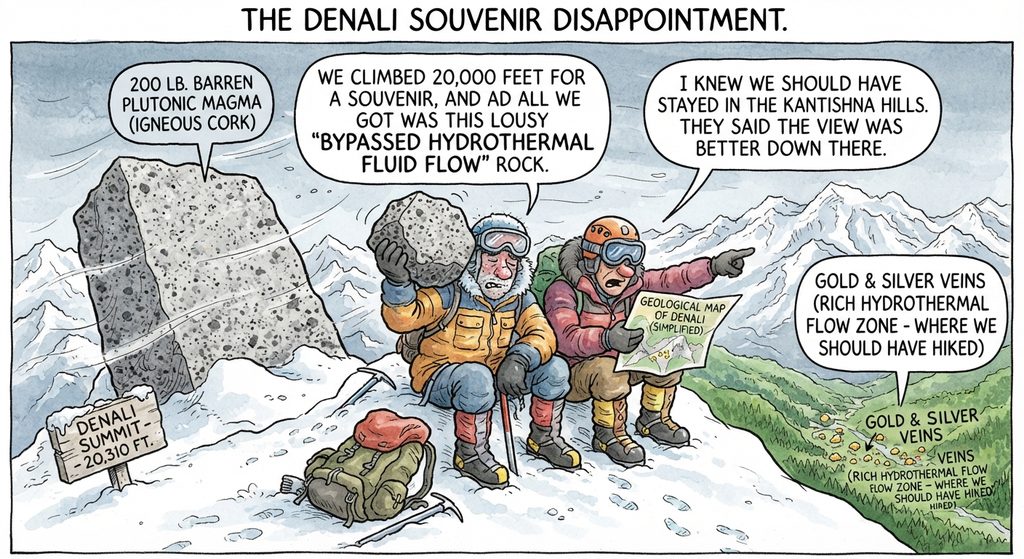
Jokes About Missing the Gold and Silver for the Granite on the Summit
- “I climbed 20,310 feet for a souvenir and all I got was this lousy chunk of un-mineralized magma.”
- “Nothing hurts more than getting to the summit of Denali and realizing you carried a 50-pound pack up a mountain that forgot to get hydrothermally cooked.”
- “My hands are frostbitten, my lungs are burning, and my geologist friend just told me my summit rock bypassed the entire silver vein.”
- “You know you’re an unlucky prospector when you climb the highest peak in North America just to find out the gold stayed in the valley.”
- “I risked an avalanche for high-grade granite when I could have stayed in the foothills and tripped over a vein of gold.”
- “We survived the Death Zone just to look at a giant, cooled block of magma that completely ghosted the hydrothermal fluid flow.”
- “The ultimate mountaineering disappointment is realizing the mountain you just conquered is just a giant, barren geological cork.”
Jokes About McKinley Summit Stone Only Being Good Enough for a Kitchen Counter
- “I paid twenty grand to summit Denali, and all I got was this 400-pound kitchen island slab.”
- “You know you’re a hardcore climber when your souvenir countertop requires a heavy-duty crane and a team of Sherpas.”
- “Nothing says ‘luxury kitchen remodel’ quite like a countertop that cost three frostbitten toes and an emergency helicopter evacuation.”
- “My wife wanted a granite countertop with a story, so I literally dragged a piece of Mount McKinley through an avalanche.”
- “Forget quartz—my kitchen counters are made of pure, high-altitude alpine suffering.”
- “The contractor asked if I wanted polished or matte, and I said, ‘I prefer the texture of a 20,000-foot tectonic uplift.'”
Mini Deep Dive on Why Mount McKinley Is Not Mineral Rich
If a mining company were to set up operations on the literal slopes and peaks of Mount McKinley (Denali) itself, they would quickly go bankrupt.
The peak has virtually nothing worth mining. The geological core of the main mountain massif is completely barren of precious metals, fossil fuels, or rare tactical minerals. [1]
The actual mountain consists of just two things:
High-Grade Industrial Granite (Quartz Monzonite)
The entire mass of Mount McKinley is an enormous, buoyant chunk of plutonic igneous granite. [1, 2]
- What is it? It is a highly durable, erosion-resistant mixture of quartz, potassium feldspar, and plagioclase.
- Is it worth mining? No. Granite is exceptionally common across the globe. Blasting it off a 20,000-foot ice-capped peak in the middle of sub-zero wilderness to use as gravel or countertop slabs is economically impossible. [1, 2]
Barren Metamorphic Layering (The “Roof Pendant”)
Near the higher elevations of the peak, there is a dark cap of ancient sedimentary and metamorphic rocks (like schist, slate, and quartzite) that the granite pluton pushed upward as it swelled out of the Earth’s crust. [1, 2]
- Is it worth mining? These specific layers on the central massif do not contain the heavily mineralized fluid veins found in the surrounding foothills. They are barren stone. [1]
Why is the mountain itself empty when the valleys are full?
The precious gold, silver, copper, and antimony deposits in the region require specific hydrothermal fluid flow—mineral-rich water cooking inside the cracks of the Earth. Those fluids settled and concentrated in the fractured fault lines, sedimentary basins, and lower foothill trends (like Kantishna) surrounding the base. [1, 2]
The main peak of Mount McKinley rose up as a solid, massive block of cooled magma that bypassed those fluid veins entirely. [1, 2]
Hydrothermal gold veins
Hydrothermal gold veins are essentially the plumbing system of ancient volcanoes and mountain-building zones They form when superheated, mineral-rich water is forced up through the Earth’s crust, cooling down and leaving behind solid gold
Here is the step-by-step process of how nature cooks up a gold vein:
The Heat and the Brew
Deep underground—often miles beneath the surface—magma chambers heat up the surrounding rock and ground water [0.1, 0.4]. This water becomes superheated to temperatures between 400°F and 750°F (200°C to 400°C). Because it is under immense tectonic pressure, the water doesn’t boil into steam; instead, it becomes an incredibly aggressive solvent.
Dissolving the Gold
As this superheated water circulates through the deep crust, it chemically strips out trace elements from the surrounding rocks [0.1]. It binds with elements like sulfur to dissolve tightly locked metals—including gold, silver, quartz, copper, and iron—carrying them away in a highly concentrated liquid soup [0.1].
Finding the Cracks
When tectonic plates shift, grind, or uplift (the process that builds mountain ranges like the Alaska Range), the bedrock fractures [0.4]. These faults, joints, and fissures act like wide-open release valves. The high-pressure hydrothermal fluid rushes upward into these newly opened cracks [0.1, 0.4].
The Flash Flash-Precipitation (The Drop)
As the fluid moves higher toward the surface, two critical changes happen rapidly:
- The temperature drops: The fluid meets cooler rocks [0.1].
- The pressure drops: The fluid enters wider open spaces
This sudden drop in temperature and pressure breaks the chemical bonds holding the metals in solution [0.1]. The minerals instantly “crash” out of the liquid and crystallize against the walls of the crack .
Building the Vein
Quartz is the most abundant mineral in these fluids, so it precipitates out in massive quantities, creating a stark white backdrop [0.1]. The gold drops out right alongside it, filling in the microscopic cracks and pockets within the quartz matrix [0.1]. Over thousands of years, as wave after wave of fluid pumps through the crack, the vein grows thicker and thicker.
Eventually, millions of years of wind, ice, and rain erode the upper layers of mountain rock, exposing these hidden subterranean veins to modern prospectors and miners [0.1].
Mount McKinley (Denali) is Made of Magma but is not a volcano
While it is made of rock that originated as magma, it belongs to a completely different geological category called a pluton (or a batholith) [0.1, 0.4].
The structural and behavioral differences between the two formations explain why Denali is fundamentally different from a volcano:
Magma Underground vs. Lava on top
- Volcanoes: Form when magma breaks through the Earth’s surface and erupts as lava, building up a cone of ash and hardened volcanic rock (like basalt or andesite) over time.
- Plutons (Denali): Form when a massive bubble of magma rises into the Earth’s crust but stalls out miles below the surface [0.1]. It never erupts. Instead, it gets trapped underground, cooling and solidifying agonizingly slowly over millions of years.
The Crystal Evidence: Granite
Because Denali’s magma cooled slowly underground, it had time to grow large, interlocking mineral crystals [0.1]. This slow-cooled magma becomes granite [0.1].
True volcanoes cool very quickly in the open air, resulting in fine-grained rocks with tiny crystals. If Denali had erupted as a volcano, it would be made of volcanic rocks like rhyolite, not massive blocks of coarse-grained granite [0.1].
Tectonic Elevator
Denali is only visible today because it was pushed into the sky by tectonic forces. About 60 million years ago, the granite core solidified deep underground [0.1]. Over the last few million years, intense squeezing along the Denali Fault acted like a giant geological elevator, thrusting that massive, hardened block of granite 20,000 feet straight up into the atmosphere while the softer surface rocks eroded away [0.1].
So while a volcano is a mountain built by stacking material on top of the Earth, Denali is a mountain created by pushing a deep, solid basement rock up from below [0.1].