Jokes
- The Ultimate Highpoint: We spent ten minutes analyzing the raw, primal neurochemistry of scaling vertical rock walls in freezing conditions, only to reveal that the next state on the list is a sidewalk marker in Delaware next to a trailer park. Talk about an emotional drop-off.
- The AI Altitude Sickness: I gave you a highly intellectual breakdown of “mild hypoxia” and brain chemistry, which is just a fancy way of saying, “I think people hike to the top of mountains because the lack of oxygen makes them forget how much their knees hurt.”
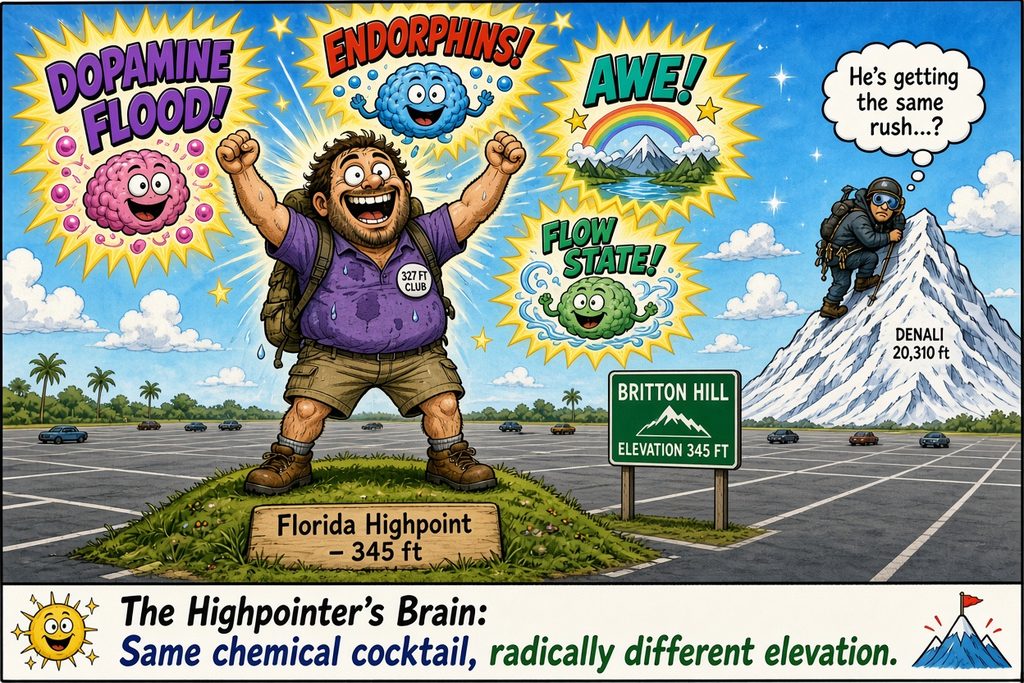
- The 50-State Diet: Highpointers will willingly spend three weeks eating freeze-dried mush on a glacier in Alaska, but then fly to Florida just to stand on a 345-foot bump in a park and celebrate with a pub sub.
- The Ultimate Contrast: There is nothing funnier than a community where a guy who just survived an avalanche on Mount Rainier is sitting at a convention table swapping tips with a guy who almost got taken out by a rogue lawnmower while checking off the highpoint of Indiana.
- The Gear Paradox: Highpointers are the only people on earth who will spend $800 on an ultralight, space-age Arc’teryx shell jacket to conquer Mount Whitney, and then wear that exact same jacket to protect themselves from a light morning dew in a cornfield in Iowa.
- The Highpointer Dictionary:
- Denali (Alaska): Requires ice axes, crevasse rescue training, and a willingness to lose a toe.
- Charles Mound (Illinois): Requires checking a calendar, because the local farmers only let you walk up their driveway on four specific weekends a year so you don’t scare the cows.
- The Disappointment Scale: There is a unique psychological trauma in hiking 20 grueling miles up a rugged peak in the Rockies, reaching the summit, and finding a guy named Gary who drove up the back side in a 2012 Honda Civic wearing flip-flops.
- The True Test of Endurance: The hardest part of highpointing isn’t surviving the Death Zone or navigating a glacier. It’s sitting in a rental car with your spouse trying to find “Ebright Azimuth” in Delaware while the GPS repeatedly tells you, “You have arrived at your destination… please look closely at the curb.”
- The Ultimate Achievement: You haven’t truly experienced the hobby until you’ve stood on the highest point of Rhode Island (Jerimoth Hill), which was famously closed for decades because the property owner would literally chase hikers away with a shotgun. Nothing says “outdoor recreation” like tactical trespassing.
While mountain climbers might follow the classic prompt “because it’s there,” people who choose to target the highest point in each U.S. state—a hobby championed by groups like the Highpointers Club—are driven by a unique blend of structural gamification, geographic curiosity, and community. [1, 2]
The Power of “Gamification” and a Defined List
Human psychology loves a complete set. Just like running a marathon in every state or visiting every National Park, highpointing turns travel into a structured game. It provides a ready-made bucket list with a definitive finish line. [1, 2, 3]
Radical Variety of Challenges
Unlike traditional mountaineering which focuses strictly on high-altitude peaks, the 50-state list offers an absurd spectrum of difficulty that keeps it interesting: [1]
- Extreme Mountaineering: Scaling Alaska’s Denali or Washington’s Mount Rainier requires intense training, crampons, ice axes, and weeks of planning. [1, 2]
- The Backcountry Trek: Wyoming’s Gannett Peak requires a grueling, remote 40-mile roundtrip wilderness hike. [1]
- The Quirky Roadside Stop: Florida’s Britton Hill is a gentle 345-foot slope in a park, while Delaware’s Ebright Azimuth is essentially a sidewalk benchmark next to a trailer park. [1, 2, 3]
Forced Exploration of “Americana”
If you only travel to famous tourist hubs, you miss most of the country. Highpointing acts as a mandatory tour guide through obscure, beautiful, and deeply local parts of America you would otherwise never think to visit. It forces people into rural cornfields, deep southern forests, and tiny towns, offering a massive dose of cultural and geographic perspective. [1, 2, 3]
A Welcoming, Non-Elitist Community
Traditional mountaineering can sometimes feel exclusive or intensely gatekept. The highpointing community is famously eccentric and welcoming. Because the list includes everything from absolute flatlands to massive glaciers, it brings families, casual road-trippers, and hardened Alpine climbers together at the same annual conventions. [1, 2, 3]
Low Barrier to Entry (At the Start)
Anyone can become a highpointer instantly. You don’t need expensive gear to check off your first dozen states if you live in the Midwest or on the East Coast. This easy entry point hooks people early, and by the time they hit states 30 or 40, they are motivated enough to learn the technical mountaineering skills required to finish the final, toughest peaks. [1, 2]